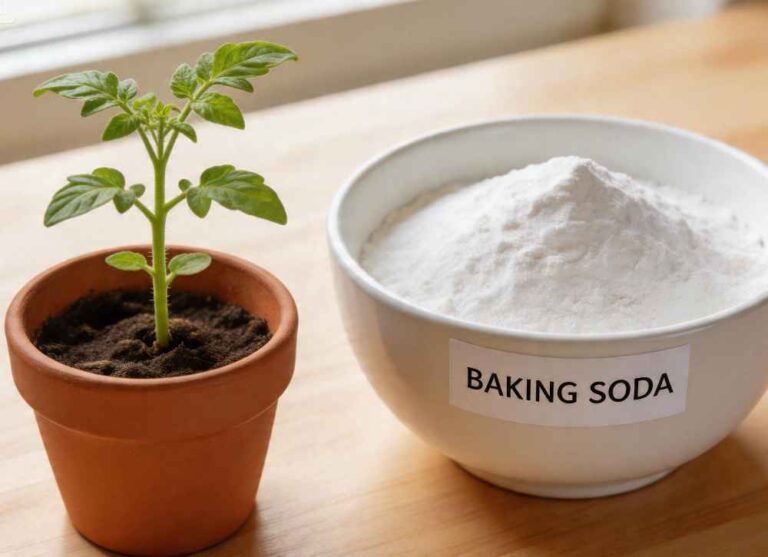
You’ve probably seen it a thousand times on Pinterest or in Facebook gardening groups: someone claiming that the secret to a perfect garden is sitting right in your kitchen cupboard. I’m talking about baking soda.
It sounds like the perfect “hack,” right? It’s cheap, it’s natural, and we already have it. But as someone who cares about their plants, I always pause before spraying anything. I mean, is baking soda good for plants, or are we just following another internet myth?
I decided to dig into the actual research to see if there’s science behind the hype. What I found was. Well, it’s complicated. It’s not a simple “yes” or “no,” but rather a “yes, if you do it exactly right.”
- Is Baking Soda Good for Plants or Not? What Science Says
- Is Baking Soda Good for Plants' Health? Here are Research-Based Benefits
- The Impact of Baking Soda on Soil and pH Levels
- Risks of Baking Soda for Plants: Why You Must Be Cautious?
- How to Use Baking Soda Safely for Plants?
- Is Baking Soda Good for Plants? Final Thoughts
Is Baking Soda Good for Plants or Not? What Science Says
When I started looking at the data, the first thing that jumped out at me was the “dose.” Think of it like vitamins for humans: a little bit is great, but a whole bottle is a disaster.
Research from MDPI Agronomy really cleared this up for me. They found that in very tiny amounts (specifically around 2.0 mmol/L), sodium bicarbonate, the scientific name for baking soda, can actually give plants a little boost.
It helps with “intracellular water metabolism,” which is just a fancy way of saying it helps the plant better manage its water and nutrients.
But here’s the catch: the moment you add too much, it flips. If the concentration becomes too high, the plant becomes stressed. It struggles to “breathe” (transpiration) and can’t make food as efficiently (photosynthesis). So, when we ask, ” Is baking soda good for plants?, we have to remember that “more” is definitely not “better” here.
Do You Know? Baking soda also helps kill fungus gnats. Here you can learn more about it.
Is Baking Soda Good for Plants’ Health? Here are Research-Based Benefits
Most of us aren’t trying to change our plant’s metabolism; we want to get rid of that annoying white powdery stuff on our zucchini leaves. This is where baking soda actually shows some muscle.
Baking Soda is The Fungus Fighter
Baking soda is alkaline. When you spray it on a leaf, it changes the pH of the leaf’s surface. Fungus spores are like picky houseguests; they need very specific conditions to grow.
By making the leaf surface more alkaline, you’re basically making the environment “unlivable” for them. A study in the Indonesian Journal of Laboratory actually looked at using this as a “green” fungicide for chili pepper plants. It’s a great way to manage Fusarium wilt without resorting to heavy chemicals.
The Virus Surprise
This part actually surprised me. I found that baking soda might even help with viral infections, such as the Cucumber Mosaic Virus.
It doesn’t necessarily “kill” the virus, but it seems to help the plant stand its ground. It’s interesting to see that baking soda is good for plants in ways that even many experienced gardeners don’t realize.
The Impact of Baking Soda on Soil and pH Levels
Here is where I started to get a bit worried. Baking soda is a salt. If you’ve ever seen what salt does to a sidewalk in winter, you know it can be harsh.
If you keep spraying baking soda and it drips down into the soil, the sodium can build up. High sodium levels make it hard for roots to drink water. Even if the soil is soaking wet, the plant can actually die of thirst because the salt is blocking the intake.
So, while baking soda is good for plants as a quick fix for a leaf problem, you have to be careful not to let it ruin your soil in the long run.
Risks of Baking Soda for Plants: Why You Must Be Cautious?
Before you go running to the pantry, there are two big “red flags” from the research:
A study in MDPI Horticulturae found that while baking soda is effective at killing ball moss, it can “blindly damage” the plant it’s sitting on. It can damage the tiny hairs on the plant’s leaves, which it uses to absorb nutrients.
If you mix it too strongly and the sun hits it, you’ll end up with brown, crispy leaves. It’s a sad sight, believe me.
How to Use Baking Soda Safely for Plants?
After reading all this research, I realized that if I’m going to use it, I need a safe “Home Gardener” formula. You can’t just wing it.
My Go-To Recipe for Baking Soda for Plants
- 1 Gallon of Water (Rainwater is best if you have it).
- 1 Tablespoon of Baking Soda (Don’t heap it!).
- 1/2 Teaspoon of Mild Liquid Soap (Like Castile soap). This helps the mixture stick to the fungus instead of just rolling off the leaf.
The Rules I Follow, and You Must Follow
- I always spray just one leaf first and wait two days. If that leaf looks fine, I do the rest.
- I only spray in the evening or very early morning. Never when the sun is beating down.
- I only use it when I actually see a fungus problem starting.
Is Baking Soda Good for Plants? Final Thoughts
So, what’s the bottom line? Is baking soda good for plants? Yes, but it’s a tool, not a miracle. It’s fantastic for spot-treating fungus and helping with certain soil issues, but you have to respect the science behind it.
Use it wisely, keep your concentration low, and always listen to what your plants are telling you. Sometimes, a little bit of kitchen science is exactly what a garden needs!