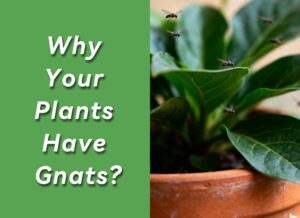
An environment rich in moisture and organic matter allows their population to explode.
If you are noticing a few gnats buzzing around your plants, simple home remedies like Neem oil, vinegar traps, baking soda, or cinnamon are often enough to keep them at bay.
However, if the infestation spreads beyond a few pots and takes over your entire yard, more decisive action is needed.
While many turn to hydrogen peroxide for a mid-level fix, it often provides only a temporary solution.
For long-term control of a massive gnat population, BTI is the gold standard that professional gardeners rely on.
While both BTI and hydrogen peroxide target larvae, using them together is not recommended. Hydrogen peroxide is an oxidative treatment that provides an immediate “hit,” but it can harm the beneficial microbes in BTI and the soil if applied simultaneously. Choosing between hydrogen peroxide and BTI is the safest and recommended method.
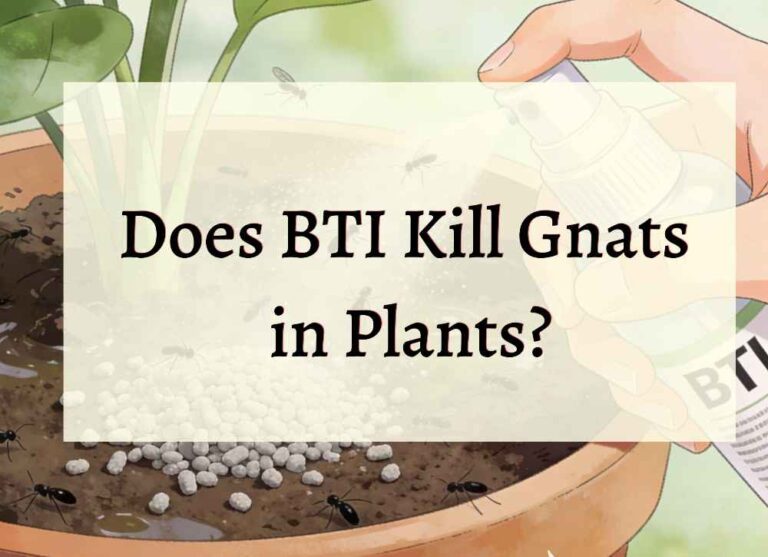
Whenever applying only BTI on plants to kill gnats, one should explore whether BTI really kills gnats. The short answer is yes, BTI is highly effective at killing fungus gnats by targeting them at the larval stage.
As a specialized bacterium, it disrupts the digestive systems of soil-dwelling larvae, effectively preventing the next generation of gnats from flying.
What is BTI for Fungus Gnats?
BTI stands for Bacillus thuringiensis israelensis, a naturally occurring soil bacterium that acts as a highly specific biological insecticide.
It works by producing toxin-laden crystals that specifically target the larval stage of fungus gnats, mosquitoes, and blackflies, disrupting their digestive systems once ingested.
This is critical for plant health because, while adult gnats are merely a nuisance, their larvae (small whitish maggots) feed on organic matter and chew on fine plant roots, which can stunt growth or kill seedlings. (Explore here whether gnats are harmful to plants in detail.)
Because BTI is a targeted biological agent, the EPA confirms it has “no toxicity to people” and is safe for pets, birds, and beneficial insects.
However, it is vital to use the correct strain; other variants, such as those for caterpillars, will not work. Gardeners should also avoid mixing BTI with hydrogen peroxide, as Reddit community insights suggest the peroxide can kill the living bacteria, rendering the treatment ineffective.
Does BTI Kill Fungus Gnats in Plants? Larvae vs. Adults
Larvae
For BTI to work, it must be ingested. When active fungus gnat larvae consume the BTI spores in the soil, the bacterium releases specific crystal proteins (Cry and Cyt toxins) that perforate the insect’s gut lining.
According to NCSU Extension, the results are almost immediate: infected larvae lose their appetite, become paralyzed, and typically die within 24 hours of the drench application.
However, there are two critical limitations to keep in mind:
- Active Feeders Only: BTI kills only larvae actively eating. Research from NovoBac and Clemson notes that it has no effect on eggs or pupae because they do not ingest the bacteria.
- Timing Matters: Some studies suggest that BTI is most effective on young larvae; older, late-instar larvae may be more resistant. This is why consistent treatment is necessary to catch newly hatched larvae.
Adult Gnats
It is a common misconception that BTI will drop flying gnats out of the air. In reality, BTI has no direct effect on adult fungus gnats.
Because adults do not consume the soil or the treated material, they are never exposed to the toxins.
As stated in guidance from Clemson University, BTI is “only effective against larvae and will not kill pupae or adults.”
After you treat your plants, you will likely still see flying adults for 3 to 5 days as they finish their natural lifespan.
As NCSU Extension explains, these adults will eventually “disappear” because their life cycle has ended, and no new larvae survive in the soil to replace them.
To speed up the process, pair your BTI soil drench with yellow sticky traps to catch the surviving adults while the BTI handles the “nursery” in the soil.
How to Use BTI to Get Rid Of Gnats in Plants?
Based on research from UC IPM and leading horticultural sources, applying BTI as a “soil drench” is the most effective way to reach larvae in the root zone.
Here is a simple, step-by-step guide to making and applying your own BTI remedy:
Step 1: Choose Your BTI Product
Select an OMRI-listed organic product containing BTI. For home gardeners, Mosquito Bits or Mosquito Dunks are the most common and accessible options.
While often marketed for mosquitoes, they are officially labeled for fungus gnat control. Professional growers may prefer Gnatrol WDG, which is a highly concentrated water-dispersible powder.
Step 2: Prepare the “BTI Tea” Drench
You need to get the bacteria into the water so they can penetrate the soil.
- If using Mosquito Bits/Dunks: Steep a few granules (or broken pieces of a Dunk) in water for about 30 minutes to create a “BTI tea.”
- If using Gnatrol powder: Mix approximately 0.5 to 3 teaspoons per gallon of water, depending on how severe your gnat problem is.
Step 3: Apply to the Soil
Slowly pour the mixture onto the top 1–2 inches of the potting soil.
According to UC IPM guidelines, you need to wet the surface layer thoroughly where the larvae live, but avoid “leaching” (don’t flood the pot so much that all the BTI runs out of the bottom drainage holes).
Using a watering can or a low-pressure spray bottle ensures even coverage.
Step 4: Repeat to Break the Cycle
Since BTI targets only larvae and doesn’t persist in the soil, a single treatment isn’t enough. Experts recommend reapplying every 5 to 7 days.
- The Pro Routine: Treat on Days 0, 5, and 10. This ensures that as new eggs hatch, the fresh larvae immediately ingest the BTI and die.
- Preventative Care: For ongoing protection, some Master Gardeners suggest adding BTI to your watering can every time you water your plants until the gnat population is completely eliminated.
Limitations and Cautions
- BTI does not kill eggs, pupae, or adult gnats; it only targets the feeding larval stage of the gnats.
- The bacteria do not reproduce in soil, so you must reapply every 5–7 days to catch newly hatched larvae.
- You will continue to see flying adults for several days until they reach the end of their 3–5-day lifespan.
- Never mix BTI with fertilizers or fungicides containing chlorine or copper, as these chemicals inactivate the bacterial spores.
- BTI only works in moist soil where larvae are actively feeding; it is ineffective in extremely dry soil.
- It provides no long-term “residual” protection once you stop applying it, meaning it won’t prevent future infestations.
- Research suggests older larvae (late instars) are more resistant, so early and consistent treatment is vital.
- While BTI is non-toxic to humans and pets, avoid inhaling the dust from powder formulations and do not apply it to already stressed plants.
How Long Does BTI Take to Kill Gnats in Plants?
According to research from NCSU Extension and agricultural experts, BTI acts very quickly once ingested, typically killing gnat larvae within 24 to 48 hours.
However, fully clearing an infestation takes more patience, as BTI does not kill eggs already in your soil.
Since these eggs hatch at different times, you should expect the total control process to span 1 to 3 weeks.
Most horticultural guidelines suggest reapplying a BTI drench every 5 to 10 days to catch each new “wave” of hatching larvae.
In practice, while you may notice a significant drop in gnat activity after the first week, it usually takes two or three consistent treatments, roughly 15 to 20 days in total, to completely break the life cycle and prevent new adults from emerging.
To speed up this timeline, experts recommend pairing your BTI treatments with yellow sticky traps to simultaneously remove the egg-laying adults. Some plants themselves also repel gnats.