When you grow tomatoes, you quickly learn that water is more than just a drink; it is the very structure of the plant. A tomato plant is a hydraulic machine.
It uses water pressure to stay upright, to stay cool in the sun, and to move food from the soil up to the highest leaves.
When we talk about underwatering, we aren’t just talking about a dry plant; we are talking about a plant that has been forced into a survival crisis.
Underwatering triggers a series of emergency choices within the plant. Because the tomato can’t find enough moisture in the soil, it starts to shut down non-essential parts to protect its core.
It will sacrifice its flowers, let its bottom leaves die, and even stop the growth of its fruit just to keep the main stem alive.
As a gardener, you have to learn to read these signs early. By the time a plant is completely flat on the ground, a lot of internal damage has already been done.
My goal here is to help you spot the “whispers” of thirst before they become “screams.” However, an overwatered tomato plant also causes damage to the roots, leaves, flowers, and even the tomato fruit
What Do Underwatered Tomatoes Look Like Overall?
A healthy tomato plant should look proud, stiff, vibrant, and reaching for the sky. When a plant starts to go thirsty, the first thing it loses is that sense of vigor.
You’ll notice the plant looks tired. It starts to sag, and the branches don’t seem to have the strength to hold themselves up. This isn’t just a physical droop; it’s a loss of internal pressure.
One of the most subtle signs I’ve noticed is what I call the matte phase. Healthy tomato leaves have a natural, almost waxy shine because their cells are plump and smooth.
When the plant is running low on water, it closes its breathing pores to hold onto moisture.
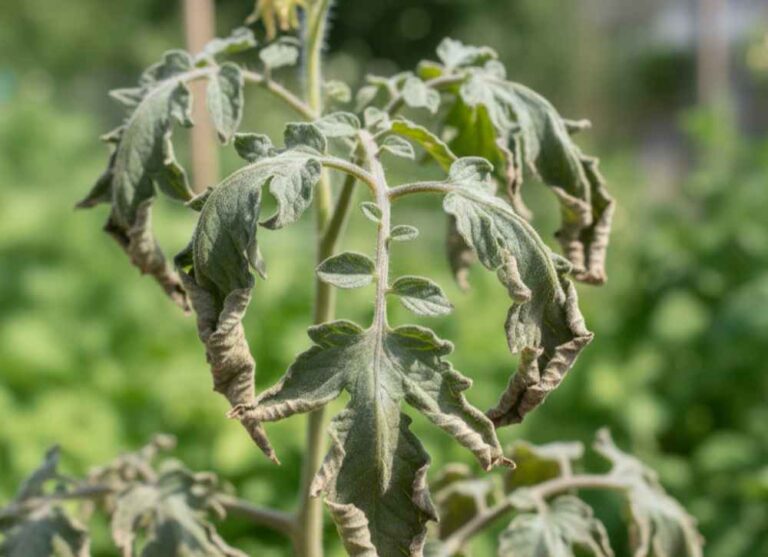
This causes the surface of the leaf to become microscopically rough, making the plant look dull, grayish, or dusty. The color might still be green, but the sparkle is gone.
If the drought continues, the plant will start to look thin and leggy. It actually sheds its own bulk to reduce the amount of water it needs to survive.
What Do Underwatered Tomato Roots Look Like?
Roots are the engine room of your tomato plant, and they suffer quietly underground. In a perfect world, your tomato roots are bright white or creamy, firm, and fuzzy with millions of tiny root hairs.
Those hairs are the part that actually does the drinking. When the soil stays dry, those delicate hairs are the first things to die, often within just a few hours.
Underwatered roots will change color, turning a dull tan or even brown . Instead of being plump and flexible, they become thin, thready, and brittle.
If you were to pull up a thirsty plant, the roots might snap like dry thread rather than bending. Another big sign is that the roots actually shrink.
As the moisture leaves the root ball and the surrounding soil, the whole mass pulls away from the edges of the pot or the garden hole .
This creates a gap that makes it even harder for the plant to drink the next time you water it.
In extreme cases, the roots will actually produce a waxy coating to try and waterproof themselves, which is the plant’s way of locking its remaining water inside .
What Do Underwatered Tomato Seedlings Look Like?
Seedlings are like infants; they have no “back-up” water stored in their stems. Because their roots are shallow, they only have access to the very top layer of soil, which dries out the fastest.
A thirsty seedling will go from fine to flat in the span of a single afternoon if it’s sitting in a sunny window or under a hot grow light. The most obvious sign is the flop.
The tiny stem just gives up and the plant lays down on the dirt. The leaves will feel like thin tissue paper, fragile and weightless. You might also see the bottom leaves turn yellow or even a deep purple.
While purple can mean the room is cold, in a thirsty seedling, it usually means the plant is struggling to move phosphorus around because the soil is too dry for the roots to work.
If you don’t catch it quickly, the tips of those tiny leaves will turn brown and crispy, and that tissue is gone for good.
What Do Underwatered Tomato Leaves Look Like?
The leaves are the plant’s primary communication tool. When a tomato is thirsty, the leaves go through a predictable series of changes.
First is the cupping or rolling. The leaf edges will curl upward or inward. This is a survival trick where the plant is trying to hide its breathing pores from the sun to stop water from evaporating.
Then comes the wilting. The leaves lose their firmness and hang down like wet rags.
A key rule I follow: if the leaves droop in the afternoon but look perfect the next morning, the plant is just reacting to the heat.
But if they are still limp at 6:00 AM, the soil is bone-dry and the plant is in an emergency state. If the thirst lasts, the leaves will start to turn yellow, usually starting at the bottom.
The plant is literally “cannibalizing” its old leaves to send what’s left to the new growth at the top. Finally, you get crisping, where the edges turn brown and brittle. If you touch a crispy leaf, it will crumble into dust.
What Do Underwatered Tomato Stems Look Like?
The stem is the plant’s main highway for water. Because it’s a thicker, sturdier structure, it’s often the last part to show signs of trouble.
When a tomato stem starts to look bad, you know the plant is severely dehydrated. A healthy stem is rigid and strong. A thirsty stem becomes rubbery and flexible .
You might notice the stem looks slightly “wrinkled” or sunken, like a straw that’s being squeezed. This makes the stem very weak.
If your plant is loaded with ripening fruit, a dehydrated stem can easily crease or snap under the weight. These weak stems also become a magnet for pests.
Bugs that suck juices from the plant find it much easier to bite into a soft, limp stem than a firm, well-hydrated one .
What Do Underwatered Tomato Flowers Look Like?
Flowering is the most expensive thing a tomato plant does. It takes a massive amount of energy and water. When the plant realizes water is scarce, it will often “abort the mission” to save itself. This is called blossom drop.
The plant grows a small layer of cells that physically cuts the flower off the vine, and you’ll find yellow flowers lying on the ground. Any flowers that stay on the plant will look shriveled and “burnt” at the edges of the petals.
Even more importantly, the pollen inside the flower can dry out or become clumpy in high heat and low water, which means the flower will never turn into a tomato.
This is why a thirsty period in July often results in a “gap” in your harvest in August.
What Do Underwatered Tomato Fruit Look Like?
The fruit is basically a water balloon. If the water supply is interrupted while the fruit is growing, the quality drops immediately.
The most common problem is blossom end rot. It looks like a big, leathery, black patch on the bottom of the tomato.
This isn’t a disease you can spray; it’s a sign that the plant was too thirsty to move calcium down to the bottom of the fruit .
Thirsty tomatoes also tend to have very thick, tough skins. The plant grows this “leathery” skin to try and hold onto the water it has inside.
Inside, the fruit might feel mealy or grainy rather than juicy and smooth. You might also see cracking or splitting.
This happens when a plant has been kept too dry, and then you suddenly give it a huge soak or it rains heavily. The inside of the tomato grows so fast from the sudden water that it literally bursts through its skin.
How Do You Know If You Are Underwatering Tomatoes?
You can’t always trust the surface of the soil. It can look dry on top while being muddy six inches down, or it can look moist on top while the roots are bone-dry. To really know, you have to use a few simple tricks.
The Finger Test: Stick your finger two or three inches into the soil near the base of the plant. If it feels like a wrung-out sponge, you’re good. If it’s dry and dusty at your fingertip, it’s time to water.
The Skewer Test: This is like checking a cake. Push a wooden skewer or a chopstick deep into the soil and leave it for a minute. If it comes out dark and damp with bits of soil clinging to it, there is moisture at the roots. If it comes out clean and dry, the plant is thirsty .
The Heft Test: For container plants, get used to the weight of a freshly watered pot. A thirsty pot will feel surprisingly light when you try to tilt or lift it.
Practical Signs You Are Underwatering Tomato Plants
Watch how the soil behaves when you water. If the water beads up and runs off the surface or down the gaps between the soil and the pot, your soil has become hydrophobic, which basically means the dirt is so dry it is now “water-hating”.
To fix this, you have to water very slowly or soak the entire root ball in a tub of water to “re-teach” the soil how to absorb moisture .
Another sign is the “Morning Check.” As a rule, your tomatoes should look their absolute best at sunrise when the air is cool and the humidity is high.
If you see a plant wilting at 6:00 AM, that is a 100% guarantee that you have an underwatering problem . Also, keep an eye on soil cracks.
If you can drop a coin into a crack in your garden bed, the soil is shrinking away from the roots, and your plants are losing their connection to their food and water source.
Using a thick layer of mulch, like straw or wood chips, is the best way to prevent all of these problems by acting as a “security blanket” that keeps the moisture where the roots can reach it.