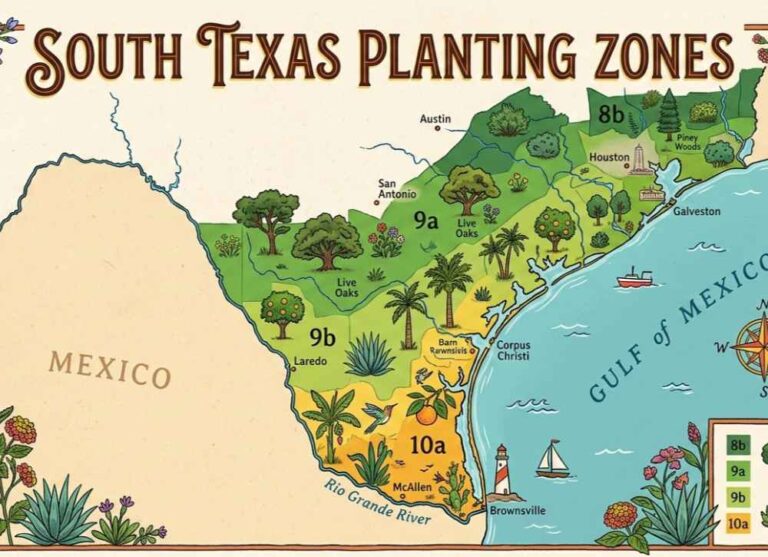
South Texas sits in USDA hardiness zones 9a, 9b, and 10a, based on the 2023 USDA Plant Hardiness Map used for the 2026 season. That means average winter lows here range from about 20°F in the northern edge to 35°F at the tropical tip near the Rio Grande Valley, giving South Texas one of the longest, warmest growing seasons in the country.
Gardening in South Texas feels like being in a tropical paradise. While gardeners up north are worried about ice and snow, the south is usually enjoying sunshine and warm breezes. The 2023 USDA Plant Hardiness Map (planthardiness.ars.usda.gov) pushed most of this region even further into the warm zones, so much of it now sits in Zone 9 or the very tropical Zone 10.
Warm winters change everything about how you garden. The season almost never stops, and you can grow plants here that would never survive a winter in the colder northern half of the state.
- South Texas Cities and Their USDA Zones
South Texas Cities and Their USDA Zones
Because “South Texas” covers everything from Laredo to the Gulf, the exact zone shifts city to city. Here is a quick reference so you can pin down your own spot.
| City / Area | USDA Zone | Average Winter Low |
|---|---|---|
| Laredo | 9a | 20°F to 25°F |
| Corpus Christi | 9a to 9b | 20°F to 30°F |
| Beaumont / Port Arthur | 9a to 9b | 20°F to 30°F |
| Victoria | 9a | 20°F to 25°F |
| McAllen | 10a | 30°F to 35°F |
| Brownsville | 10a | 30°F to 35°F |
| Harlingen | 10a | 30°F to 35°F |
The pattern is simple: the closer you get to the Gulf and the Rio Grande, the warmer your zone. If your town is not listed, match it to the nearest city above.
The Tropical Zones of South Texas: 9a, 9b, and 10a
South Texas splits into three main zones that tell you how warm it stays in winter. These zones, 9a, 9b, and 10a, are shaped by the warm water of the Gulf of Mexico.
The climate here stays moist and warm even at night, much like the sticky summer air that defines Houston’s growing conditions. This subtropical setting is ideal for heat-loving plants, but it also means the summer sun can be brutal. Sitting so far south, the region acts like a bridge between the dry brush country and the ocean.
Gardening in the Brush Country: Zone 9a and 9b
The northern and middle parts of South Texas, including Laredo, Corpus Christi, and areas near San Antonio, fall into Zone 9. Winter temperatures stay between 20°F and 25°F in Zone 9a, while Zone 9b is a touch warmer at 25°F to 30°F. This is warmer than the chillier conditions gardeners deal with up in North Texas, which changes what you can safely leave in the ground over winter.
The soil here is often a mix of heavy clay and sandy loam, so drainage and watering matter as much as temperature. It is a great place for Texas Superstar plants like esperanza and hibiscus, which love the long summers and shrug off the very short winters. Heat-loving vegetables do well too. In fact, the long warm season is exactly why so many gardeners here have luck with growing tomatoes in Texas well outside the usual spring window.
The biggest challenge in Zone 9 is keeping plants watered through the dry spells between rainstorms.
The Tropical Tip: USDA Zone 10a
As you move to the very bottom of the state, into the Rio Grande Valley near Brownsville and McAllen, you enter Zone 10a. This is the warmest part of the entire state, where winter lows rarely dip below 30°F to 35°F.
This corner feels far more tropical than the hills around Austin. The soil is often rich and fertile, which is why the Valley is famous for Ruby Red grapefruit and oranges. Here you can grow true tropicals like bougainvillea, papaya trees, and many palms that would freeze anywhere else. The only real winter task is occasionally covering your most sensitive tropicals if a rare cold front slips through.
What Can You Grow, and When? A South Texas Planting Calendar
The real reason people look up their zone is to know what to plant and when. Here is a simple seasonal guide for zones 9 to 10a.
| Season | What to Plant |
|---|---|
| Late winter (Jan to Feb) | Tomatoes, peppers, and eggplant started early; last frost often passes by mid-February |
| Spring (Mar to Apr) | Beans, squash, cucumbers, melons, and heat-loving herbs |
| Summer (May to Aug) | Okra, sweet potato, southern peas, and other true heat lovers |
| Fall (Sep to Nov) | A second round of tomatoes, plus lettuce, greens, and root crops as it cools |
| Winter (Dec) | Cool-season greens and citrus care; most beds keep producing |
Because the last frost lands so early, you can start a spring garden while much of the country is still frozen. The flip side is heat, so timing your planting to dodge the worst of summer is just as important as dodging frost. If you are new to the state, our overview of the full Texas growing season and frost dates puts these windows in context.
Success in the South Texas Sun
The secret to a great South Texas garden is protecting plants from the midday sun. Since the last frost usually passes very early, sometimes in February, you get a long head start on everyone else.
Because the sun is so strong, a thick layer of mulch is essential to hold moisture in the soil. Getting that moisture level right is its own skill, and it helps to understand the difference between soil that is nicely moist and soil that is too wet before you overdo the watering. Many gardeners here also lean on shade cloth to give vegetables a break from the afternoon heat.
Focus on plants that love sun and can handle humidity, and your South Texas garden will stay lush and colorful nearly all year. If growth still stalls despite the perfect climate, it is worth checking these common reasons plants fail to thrive.
What Planting Zone Is Southeast Texas?
Most of Southeast Texas, including Beaumont, Port Arthur, and the areas around Houston, now falls into Zone 9a and 9b, where it rarely drops below 20°F to 25°F in winter.
That is far milder than the cold snaps inland. Because the Gulf of Mexico is so close, the salt air and heavy humidity act like a warm blanket, hielding plants from the harder freezes that hit inland Texas regions further north. If you want to see how your zone fits into the rest of the state, our guide to the planting zones across all of Texas maps it out region by region.
FAQs
What USDA zone is South Texas in?
Most of South Texas is Zone 9a or 9b, and the Rio Grande Valley tip near Brownsville and McAllen is Zone 10a.
Is South Texas warm enough to grow tropical plants?
Yes. In Zone 10a you can grow papaya, bougainvillea, citrus, and palms year round, with only occasional frost protection needed.
When is the last frost in South Texas?
It is early, often around February, and the Rio Grande Valley may see almost no hard freeze at all in a mild year.
What is the hardest part of gardening in South Texas?
Heat and dry spells, not cold. Mulch, shade cloth, and steady watering matter more here than frost protection.
Explore More Texas Gardening Guides
Texas Planting Zones by Region & City
| Statewide overview of Texas planting zones | Warm, tropical South Texas zones |
| Cold-snap prone North Texas zone | Humid, mild East Texas zone |
| Arid, alkaline West Texas zone | Transitional Central Texas zone |
| Zone guide for Dallas | Zone guide for Fort Worth |
| Zone guide for Houston | Zone guide for San Antonio |
| Zone guide for Austin | Full Texas growing season & frost dates |
Growing a Lawn in Texas
| Full guide to planting grass in Texas | Choosing the best grass for Texas |
| When to plant Bermuda grass | When to plant St. Augustine grass |
| When to plant Zoysia grass | When to plant Buffalo grass |
| When to plant rye grass | When grass starts growing in Texas |
| How often to water grass in Texas | When to fertilize grass in Texas |
| How to get rid of grass burrs |
Fruit Trees & Peaches in Texas
| The top fruit trees for Texas | When to plant peach seeds in Texas |
| When to plant a pear tree in Texas | When to plant fig tree cuttings in Texas |
| When peach season hits Fredericksburg | When to plant loquat seeds in Texas |
Vegetables & Herbs in Texas
| When to plant tomatoes in Texas | How often to water tomatoes in Texas |
| Is it too late to seed tomatoes in zone 9a? | When to plant lettuce in Texas |
Growing Garlic in Texas
| Full guide: when to plant garlic in Texas | Can you plant garlic in spring in Texas? |
| When to harvest garlic in Texas |