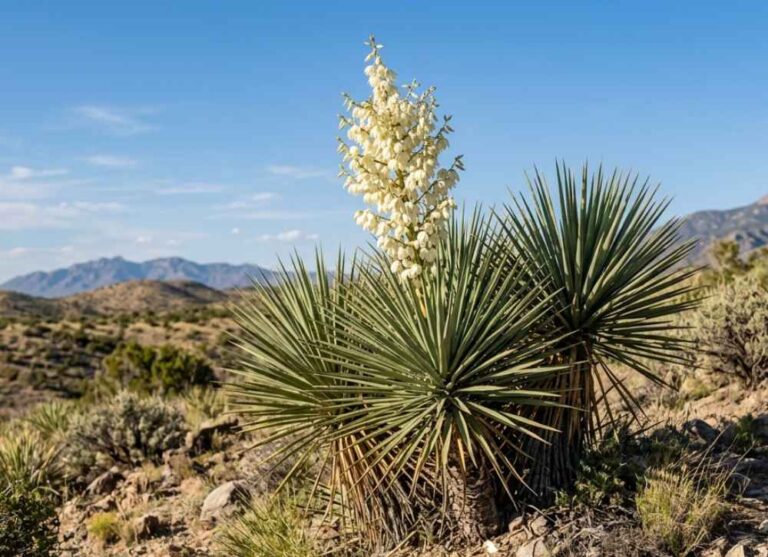
When you think of the American West, you probably picture a vast desert with a unique, spiky plant standing tall against the sunset. That plant is likely a Yucca.
Yucca plants are far more than just desert decorations. They are survival experts, ancient toolkits, and even a source of food and soap.
Belonging to the family Asparagaceae, these plants have lived alongside humans for thousands of years, providing everything from sandals to shampoo.
Whether you are a gardener, a hiker, or just curious about nature, here are ten fascinating facts about the resilient Yucca.
The Name Game: Yucca vs. Yuca
The most common mistake people make is confusing the Yucca plant with Yuca. They sound the same, but they are completely different plants with very different uses.
- Yucca (with two ‘c’s) is the desert plant we are talking about. It has stiff, sword-like leaves and beautiful white flowers. Its roots are full of saponins (natural soap) and can be toxic if eaten raw.
- Yuca (with one ‘c’), also known as Cassava, is a tropical root vegetable. It is a major food source globally and is used to make tapioca and fries.
You eat Yuca fries, but you use Yucca to make soap and rope!
2) A Love Story 40 Million Years Old
Yuccas have a “best friend” in the animal kingdom: the Yucca Moth. Their relationship is called obligate mutualism, which means neither can survive without the other.
Unlike bees that bump into flowers by accident, the female Yucca moth is a deliberate gardener. She collects pollen, rolls it into a tiny ball, and carries it to another flower. She hides her eggs inside the flower’s ovary and then “plugs” the pollen ball into the plant to ensure it grows seeds.
The plant feeds the moth’s babies (the larvae), and the moth ensures the plant can reproduce. If the moth lays too many eggs, the plant simply drops that flower to protect its resources. It’s a perfect, ancient partnership.
3) The “Crib” of Ancient Footwear
If you lived in the American Southwest 10,000 years ago, your shoes were probably made of Yucca. Archaeologists have found ancient sandals in caves that are still intact today.
Yucca leaves contain incredibly strong fibers. Native American tribes would pound the leaves to reveal these “strings,” which they then twisted into cordage. This wasn’t just for shoes; Yucca fiber was used for:
- Hunting nets and snares.
- Strong bowstrings.
- Warm blankets (woven from fiber with rabbit fur).
- Paintbrushes (by chewing the end of a leaf until it became soft and bristly).
4) Nature’s Own Soap (Amole)
Have you ever heard of a “Soapweed” plant? If you crush the roots or stems of a Yucca and mix them with water, they produce a rich, bubbly foam. This is because Yucca is packed with steroidal saponins.
Indigenous cultures like the Navajo and Zuni have used this “amole” soap for centuries. It’s famous for being a gentle cleanser that leaves hair soft and shiny. Even today, you can find Yucca extract in natural, sulfate-free shampoos.
Beyond the shower, this extract is used in the food industry. If you enjoy the thick foam on top of a Root Beer, you might be drinking a little bit of Yucca!
5) The Legendary Joshua Tree
The most famous Yucca isn’t even called a Yucca by most people; it’s the Joshua Tree (Yucca brevifolia). Legend says Mormon settlers named it because its reaching branches reminded them of the biblical Joshua reaching his arms to the sky.
Joshua Trees are the giants of the Mojave Desert. They grow very slowly, only about 1.5 inches a year, but they can live for a very long time.
While most live about 150 years, some specimens are estimated to be over 1,000 years old. They don’t have “rings” like oak trees, so scientists have to use height and carbon dating to guess their age.
6) A Natural Medicine Cabinet
Modern science is finally catching up to what traditional healers have known for ages: Yucca is a powerhouse of health benefits. The plant is loaded with antioxidants and anti-inflammatory compounds.
Many people take Yucca supplements to help relieve arthritis pain. It helps block the “triggers” that cause swelling in the body.
Some studies show that Yucca can help lower “bad” cholesterol. The high levels of Vitamin C and antioxidants help protect the skin from sun damage and aging.
7)You Can Actually Eat It (Parts of It!)
While you shouldn’t go digging up roots for dinner, the reproductive parts of the Yucca are quite tasty.
In El Salvador, the Izote (Yucca flower) is a national delicacy. People scramble them with eggs or put them in soups. They taste a bit like asparagus with a slightly bitter finish.
The “Banana Yucca” (Yucca baccata) produces a fleshy fruit that looks like a fat green banana. When roasted, it becomes sweet and tastes like molasses or sweet potato.
Young flower stalks can be harvested while they are tender, much like giant asparagus, and roasted over a fire.
8) Built Like a Water Tank
Yuccas are the ultimate desert survivors because of their brilliant engineering. They don’t just “deal” with the heat; they harvest every drop of moisture available.
Their thick, waxy skin prevents water from evaporating in the sun. The leaves are shaped like “V” channels. When it rains or when dew forms, the leaves funnel the water directly down to the center of the plant and into the roots.
As old leaves die, they don’t always fall off. They hang down around the trunk like a hula skirt, shading the plant from the blistering sun and keeping the core cool.
9) The “Eternity Plant”
In various cultures, the Yucca carries deep spiritual meaning. In the Southern United States, it was often called the “Eternity Plant.”
Because it is so hard to kill and lives for so long, it was frequently planted at gravesites, especially where people couldn’t afford expensive stone markers.
Folklore even suggested that the Yucca’s deep roots and sharp leaves would “pin” a spirit to the grave, preventing it from wandering or causing trouble for the living. It was also common to see Yucca planted near doorways as a spiritual “guard” to protect the home.
10) A Symbol of National Pride
The Yucca is so important that it has been “crowned” as an official symbol in multiple places.
In 1927, school children voted for the Yucca to become the official State Flower. It was chosen because it represents the “rugged spirit” of the people who live in the desert.
The Flor de Izote (the Yucca flower) is the National Flower of El Salvador. You can find it on stamps, in art, and in markets across the country. It is a symbol of resilience and natural abundance.