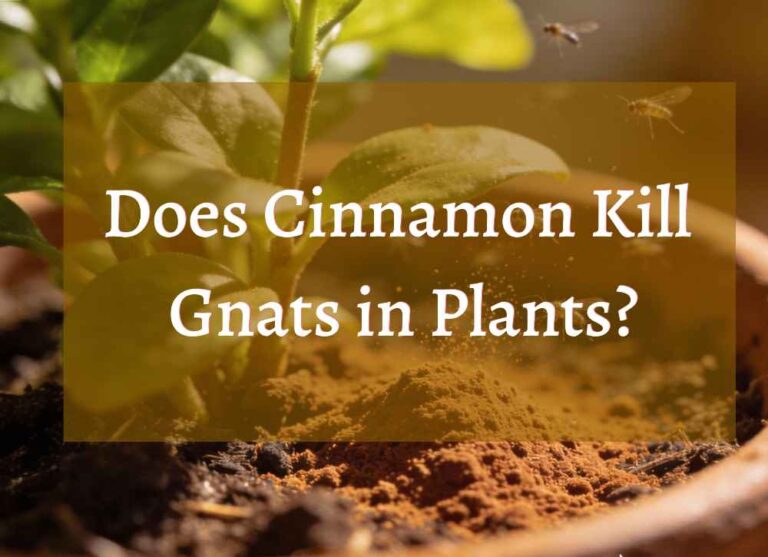
When dealing with fungus gnats, the real threat isn’t the flying adults but their larvae, which hide beneath the soil and feed on your plant’s delicate roots.
You may have mostly found it buzzing around your plants or throughout your yard. Flying gnats may not be harmful to plants, but their larvae in the soil feed on organic matter, such as roots, especially when the plant is sensitive. (See details)
While many gardeners use neem oil or vinegar to control gnats, others prefer setting up hydrogen peroxide or even baking soda as an effective soil drench.
However, a common kitchen staple, cinnamon, is often brought up. But does cinnamon actually work to kill or repel gnats as effectively as these other remedies?
Cinnamon is not a direct insecticide that kills gnats on contact; instead, it acts as a powerful “environmental disruptor” that halts their life cycle.
It works by targeting the larvae’s food source. As a natural fungicide, it destroys the soil fungi that larvae need to survive.
By wiping out the “buffet” and creating a fragrant barrier, cinnamon starves the existing larvae and discourages adult gnats from laying new eggs in your pots.
Does Cinnamon Kill Gnats in Plants? What Science Says?
While cinnamon is a staple in many gardening blogs, scientific evidence regarding its effectiveness as an insecticide is largely skeptical.
According to a recent review on PMC, cinnamon primarily acts as a repellent rather than a killer against pests.
While concentrated cinnamon essential oils have shown a “biocidal effect” (the ability to kill) in lab settings, achieving a 100% kill rate on mosquito larvae, the common ground cinnamon powder found in your kitchen has no proven toxicity to fungus gnats.
In fact, experts from Southern Living and The Spruce clarify that while the powder might repel insects, it won’t actually kill them.
Horticulturists, such as Justin Hancock from Costa Farms, explicitly state that you cannot count on cinnamon for gnat control, as there is no evidence suggesting it affects the insect directly.
Furthermore, Michigan State Extension warns that using high doses of cinnamon can damage your plants without providing reliable pest control benefits.
How does Cinnamon Work for Larvae?
Cinnamon manages gnat larvae through its antifungal properties rather than direct toxicity. Using cinnamaldehyde to eliminate surface-layer fungi effectively starves the larvae of their primary food source.
However, research from Plantura indicates that while this disrupts the reproduction cycle, it lacks a “contact kill” effect for larvae living deep in the soil.
Consequently, because larvae pupate within 2–3 weeks, many are hardy enough to survive until adulthood despite the lack of surface fungi, meaning cinnamon alone rarely eliminates an existing subterranean population.
How Cinnamon Works for Adult Gnats?
In adult fungus gnats, cinnamon acts primarily as a deterrent. It does not knock them out of the air, but it changes how they interact with your plants:
Gardeners report that dusting the soil surface with cinnamon creates a barrier that female gnats dislike. They are often repelled by the strong scent and the texture, leading them to avoid laying their eggs in “spiced” soil.
While it may discourage new eggs, it does nothing to stop the currently flying adults, which live for about 7–10 days.
Scientific sources suggest that while cinnamon may reduce the number of new infestations by covering the soil, it does not eliminate the current population of adult gnats.
How to Use Cinnamon to Get Rid Of Gnats in Plants?
Based on recent gardening practices and expert research, if you choose to use cinnamon as a preventative barrier for fungus gnats, follow these steps to maximize its antifungal and repellent effects:
Step 1: Prep the Soil Surface
Before applying anything, allow the top 1–2 inches of your potting soil to dry out. Fungus gnats, especially their larvae, thrive in moist soil and environments, and cinnamon is most effective as a dry barrier.
Step 2: Apply a “Soil Blanket”
Sprinkle a light, even layer of pure ground cinnamon across the entire soil surface.
According to Indoor Gardener, you must ensure full coverage; even small gaps in the soil can provide a landing strip for gnats to lay eggs.
Step 3: Create a Cinnamon “Tea” Spray
For a more thorough application, follow the Plantura method: mix approximately 1 teaspoon of cinnamon into 5 liters of warm water.
Let it steep for a few hours, then use the mixture to spray both the plant foliage and the soil surface to act as a mild fungicide.
Step 4: Maintain the Barrier
Cinnamon loses its potency over time, especially when it gets wet during watering. Gardeners typically re-dust the soil every 1–2 weeks to maintain the repellent scent and antifungal layer.
Step 5: Monitor the Results
Keep in mind that there is no “standardized dose” for this method.
As experts at The Spruce point out, you shouldn’t count on cinnamon alone to fix a major infestation.
If you still see adults after a week, it’s time to pair this method with sticky traps or more direct treatments.
Limitations and Cautions for Using Cinnamon to Kill Gnats in Plants
Cinnamon powder does not kill gnat larvae or adults on contact. While it may suppress surface mold, larvae can still survive by feeding on fungi deeper in the soil or on plant roots.
Adult gnats do not eat soil and are completely unaffected by cinnamon; they will continue to live out their 7–10 day lifespan regardless of how much spice you apply.
According to Michigan State Extension, cinnamon is almost certainly lethal to beneficial nematodes.
These are helpful organisms in your soil that naturally prey on gnat larvae, so using cinnamon could accidentally kill your plant’s best natural defense.
In high doses, cinnamon can damage delicate plant tissue. It is known to inhibit the growth of certain plants, such as tomatoes and cress, potentially stunting or harming sensitive seedlings.
Heavy or repeated use can stress your plants and destroy beneficial soil life without providing a guaranteed fix for the gnat infestation.
How Long Does Cinnamon Take to Kill Gnats in Plants?
If you’re wondering how fast cinnamon works, the answer is: not very fast.
There is no specific research confirming a timeline, but based on the life cycle of a fungus gnat, you wouldn’t see any change for at least 3 to 4 weeks.
Because cinnamon only discourages new eggs and doesn’t kill the insects currently living in your plant:
- You have to wait about one week for the current flying adults to die off naturally.
- You have to wait another 2 to 3 weeks for the larvae already in the soil to finish growing and leave.
Most gardeners report a very gradual decline in gnats over several weeks, but experts warn that this isn’t a guaranteed cure.
To get rid of gnats for good, experts recommend drying out the topsoil, using bottom watering, or adding a sand barrier to prevent breeding.
You can also use Yellow Sticky Traps to catch flying adults, and Mosquito Bits or beneficial nematodes to safely kill larvae in the soil.