If you’ve ever felt like you’re gardening in a sauna, you’re probably a Houstonian. Gardening in the Bayou City is a lush, vibrant experience, but it comes with its own set of rules that differ wildly from those of neighbors to the north.
The USDA map shows that Houston has officially moved into a warmer category. In the past, Houston was on the border of two zones.
Now, the city has fully embraced its subtropical weather. Most of the metro area is now officially in Zone 9.
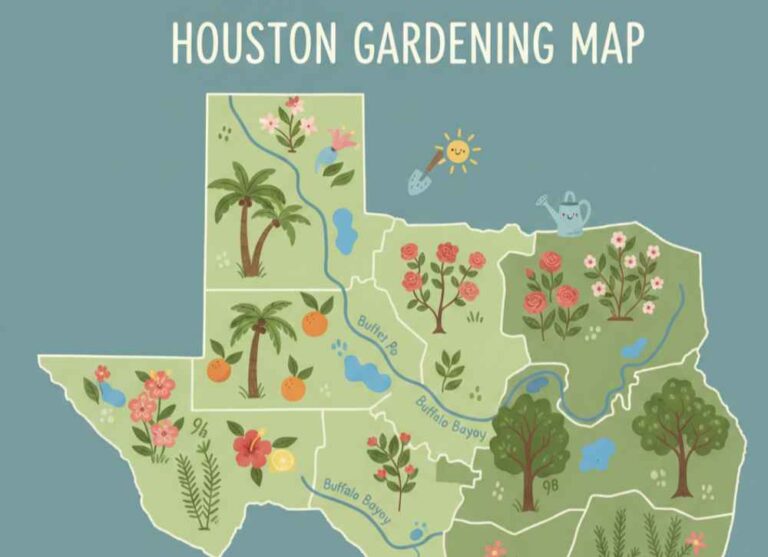
Understanding Houston Planting Zones: 9a vs. 9b
In Houston, your zone usually depends on two things: how much concrete is around you and how close you are to the Gulf of Mexico.
If I talk about their growing season, the winters are very mild, and extreme cold does not last long. However, a difference of just a few degrees determines if your Hibiscus or Ginger plants will survive the winter.
Gardening in USDA Zone 9a of Houston, Texas: The Suburban Ring
This zone covers most Houston suburbs, including Cypress, The Woodlands, Katy, and Sugar Land.
Every year, the coldest it usually gets is between 20°F and 25°F. It is much warmer than North Texas, but we still get occasional “hard freezes” that can kill sensitive plants.
The soil here is a thick, heavy clay often called “Houston Black.” In wet winters, this clay holds too much water and can drown roots. In hot summers, it dries out and cracks.
Choose “Texas Tough” plants. Dwarf Yaupon Holly is better than Boxwood because it handles the wet and dry swings.
Native flowers like Coneflowers and Texas Sage also grow well here because they don’t mind a little winter cold.
Also Read: Is it too late to plant tomato seeds in zone 9a of Texas.
Gardening in USDA Zone 9b of Houston, Texas: The Urban Core and the Coast
You are in Zone 9b if you live in high-traffic areas like Downtown, the Heights, or the Medical Center, or if you live south in Pearland or Friendswood.
Because the city’s concrete holds heat, the temperature rarely drops below 25°F to 30°F.
You have a very long growing season. You can often grow tomatoes and peppers until December. It is perfect for citrus trees like Meyer Lemons and Satsuma Mandarins.
The main problem isn’t the cold; it’s the heat. Because the city stays hot at night, plants never get a break. This can lead to heat stress and mold or fungus problems.
This is the best spot for tropical plants like Bird of Paradise and Bougainvillea.
Surviving Houston’s Humidity and Soil
The secret to a great Houston garden is surviving the “Big Damp.” Houston gets over 50 inches of rain a year, so your plants must have good drainage.
Since here, clay soil is so heavy, you must add compost or “expanded shale.” This helps the soil breathe so the roots don’t suffocate in the mud.
Many experts now suggest using Mondo Grass or Asian Jasmine instead of regular grass. These plants handle late-summer dry spells much better.
In Houston, the last freeze usually happens in late February. This means you should start planting your spring garden while people in other states are still dealing with snow.
During the hot months, use “deep watering” to reach the roots. Put a layer of mulch over your garden to keep the soil cool.
By following these steps, your Houston garden can stay green and healthy all year long.
Grid
What Planting Zone is Fort Worth, Texas? Zone 8a Vs. 8b
What Planting Zone is Houston, Texas? Zone 9a vs. 9b
What Planting Zone is Dallas, Texas? Zone 8a and 8b
Explore When to Plant Loquat Seeds in Texas
Top 4 Fruit Trees That Grow Best in Texas Yards