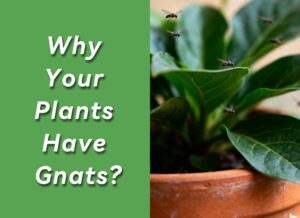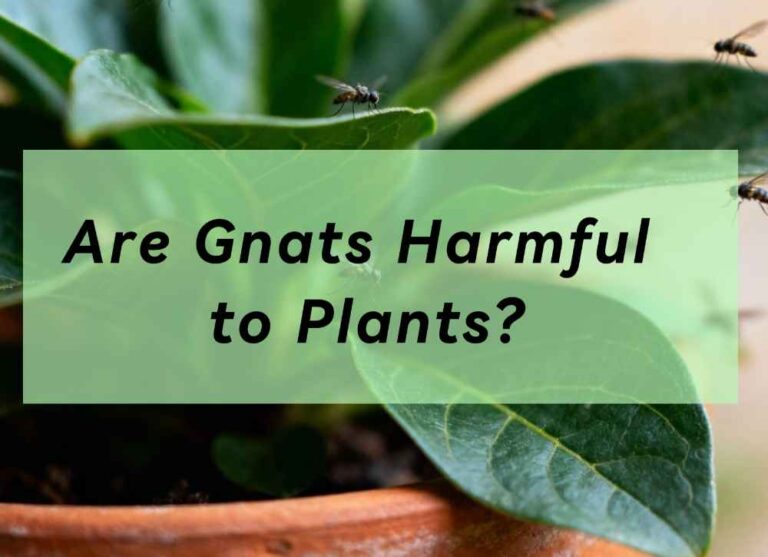
Indoor and outdoor gardeners often deal with gnats in their yard, wherever there is moist soil and decaying organic matter. Since many plants naturally create these ideal conditions, it’s normal to worry about their effect.
And as caretakers of our plants, it’s important to understand whether the fungus gnats are harmful to plants or not. The answer is simple: YES.
Fungus gnats can be harmful to plants, but the level and type of damage depend on the plant’s overall health and its growth stage.
The real damage does not come from the flying adult gnats. The actual harm is caused by their larvae, which live in the soil and feed on tender roots.
Gnat’s Damage depends on Growth Stage of Plant!
Weak and delicate plants (seedlings & young plants):
- These are the most vulnerable to fungus gnat larvae.
- Their root systems are still soft and undeveloped, making them easy for larvae to chew.
- This slows growth, causes wilting, and can even kill the plant.
- At this stage, the plant cannot defend itself, and larvae may spread pathogens like Pythium, leading to damping-off disease.
Healthy and mature plants:
- A well-established plant with a strong root system can tolerate mild larval activity.
- It usually recovers from small damage without showing immediate symptoms.
- That’s why, in some cases, fungus gnats are considered a “minor nuisance” for mature plants.
Remember!
Even though a healthy plant may survive light larval damage, fungus gnats should never be ignored. If the soil problem continues and the larvae population increases, they can eventually weaken and harm even healthy, mature plants.
Therefore, fungus gnats are indeed harmful, and controlling them is essential, especially when you are growing seedlings or young plants.
Are Fungus Gnats Harmful to Plants? Adults Vs. Larvae
The truth is, whether a plant is healthy or weak, moist and damp soil will always attract fungus gnats.
For a healthy plant, the presence of this infestation may seem like a small, temporary issue, but for a weak plant, the same infestation can become deadly.
All the real damage comes from the larvae in the soil, while the flying adults simply lay the eggs that create these harmful larvae. It means removing adult gnats is most important, because they are the foundation of larvae.
The Harmless Stage: Adults Fungus Gnats
Adult fungus gnats (the small flies you see hovering around plants) do not directly harm the plant. Their mouthparts are not for eating plant tissues or damaging roots.
Adult gnats do not chew leaves, do not suck plant sap, and do not harm the roots. They only fly around and become a nuisance to you. However, they are not harmful to you, your kids and your pets as well.
Their main purpose is reproduction. Female gnats search for moist soil surfaces where they can lay their eggs.
A single female gnat can lay 100 to 200 eggs in the right moist environment, which quickly increases the severity of infestation.
Although they don’t feed on plants, adult gnats can carry soil pathogens from one pot to another as they fly, indirectly spreading plant diseases. (Fungus Gnats, 2023)
Adult fungus gnats are a warning sign; their presence means larvae will soon be developing in the soil.
The Harmful Stage: Larvae of Fungus Gnats
A few days after the adult female lays her eggs, tiny translucent or white larvae with black heads emerge. This is the stage where plants suffer the most damage.
Larvae stay within the top one to two inches of moist soil.
- They mainly feed on algae, fungi, and decaying organic matter in the soil.
- However, when their population increases or their natural food source is depleted, they shift toward living on plant roots.
- They especially attack delicate root hairs and fine roots.
And the result appears;
Roots are responsible for absorbing water and nutrients. When larvae damage these roots, the plant cannot take up nutrients, leading to stunted growth, yellowing leaves, and overall wilting.
By wounding the roots, larvae create openings for fungal diseases (Pythium), the main cause of damping-off. Larvae can also spread these pathogens from one area to another.
Signs of Gnats Damage in Plants
When fungus gnats begin to harm a plant (meaning the larvae are attacking the roots), certain clear symptoms start to appear. These signs show that the issue has moved beyond a “minor nuisance” and has become a real problem.
Major Signs and Symptoms of Fungus Gnat Damage
These symptoms usually appear when a large number of larvae are present in the soil:
Decline in Overall Plant Health
- The plant stops growing normally. This is one of the earliest and most common signs.
- Lower and older leaves start turning yellow first. This happens because damaged roots cannot properly absorb nutrients.
- The plant begins to wilt even when the soil is wet. Since the roots are damaged, the plant cannot take up water.
- The plant looks lifeless, dull, and noticeably weak.
Specific Symptoms in Different Plant Parts
- If you remove the plant from its pot, the roots may appear dark, brown, soft, or mushy, unlike healthy white roots.
- Under stress, the plant may begin shedding its lower leaves.
Immediate Impact on Seedlings and Young Plants
- This is the most dangerous symptom. Young seedlings suddenly collapse at the base and die. This happens due to Pythium, a fungal disease spread by the larvae.
- Small plants can disappear or die within one or two days after a severe larval attack.
Visible Signs That Confirm Infestation
- Small black flying insects around the plant or soil surface are the most obvious sign.
- If you closely look at moist soil (especially after watering), you may see small, clear or white larvae with black heads crawling on the surface.
- A large number of trapped gnats indicates active reproduction and a growing infestation.
Always remember: seeing one or two adult gnats does not necessarily mean your plant is heavily damaged. However, if you notice multiple health symptoms, many adults, and visible larvae, it is a clear sign that larvae are attacking the roots.
How to Get rid Of Gnats in Natural Way?
So, after understanding whether they are harmful to plants or not. Here’s how to get rid of gnats in plants: complete methods from start to finish. And if you want to know about any specific home remedy or biological techniques to kill gnats in plants, the following list may help you;
1) Baking Soda for killing gnats
2) Neem Oil for killing gnats
3) Vinegar for killing gnats
4) Hydrogen Peroxide for killing gnats
5) Cinnamon for killing gnats
6) BTI for killing gnats
7) Nematodes for killing gnats
8) Yellow Sticky Traps for killing gnats
9) Garlic Water for killing gnats
10) Plants that naturally repel gnats