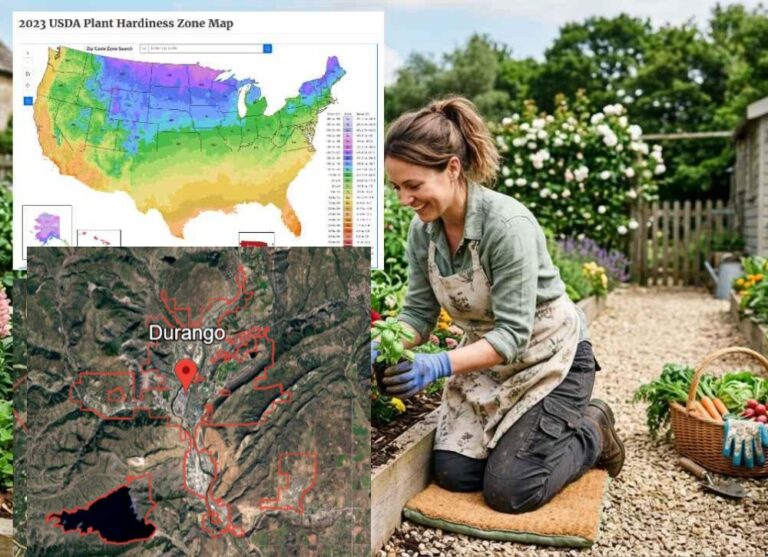
Durango confuses a lot of gardeners. It sits in southwestern Colorado at over 6,500 feet, surrounded by mountains, and yet its winters are noticeably milder than what you would expect at that altitude. People who move here from the Front Range often assume the same planting rules apply, only to find that Durango plays by a different set entirely.
The confusion makes sense. Durango is not a Front Range city, and it is not a high mountain town either. It sits in the Animas River valley at the edge of the San Juan Mountains, which gives it a unique climate that does not match neatly with Denver, Boulder, or the ski resort communities further north.
Getting your planting zone right here is the difference between a garden that produces and one that struggles against the wrong expectations. Here is exactly where Durango falls and what that means for your growing season.
Durango’s USDA Hardiness Zone
The 2023 USDA Plant Hardiness Zone Map places Durango across three zones: Zone 6a, Zone 6b, and small portions in Zone 7a.
Zone 6a covers the primary residential areas of town, where average annual extreme minimum temperatures range from -10°F to -5°F. Zone 6b applies to lower-elevation, more sheltered pockets, with minimums between -5°F and 0°F. A few of the warmest microclimates in and around Durango reach into Zone 7a territory, where lows stay between 0°F and 5°F.
PlantMaps confirms all three designations using the 2023 USDA data. Plantingzonesbyzipcode.com lists Durango primarily in Zone 6b, noting its position in the warmer southwestern region of the state.
For practical purposes, most Durango gardeners should plan around Zone 6a as their baseline and treat any warmer pockets as a bonus rather than the standard.
Why Durango’s Zone Surprises People
Durango sits at roughly 6,512 feet of elevation, which is higher than Castle Rock and comparable to many mountain communities that garden in Zones 4 or 5. Yet Durango’s zone classification lands one to two full zones warmer than you would predict from altitude alone.
The River Valley Effect
The Animas River corridor provides a natural temperature buffer that moderates winter lows. Water holds heat longer than dry land, and the river valley’s topography channels milder air through town while colder air settles in the higher terrain above.
This valley position means Durango avoids the worst of the overnight temperature crashes that hit exposed ridgelines and open plateaus at the same elevation. The sheltering effect of the surrounding mountains also blocks some of the coldest air masses that pour across the Continental Divide.
Southwestern Colorado’s Milder Pattern
Durango benefits from its position in the Four Corners region, which tends to be warmer in winter than the northern and central Rockies. The southwestern corner of Colorado often stays a few degrees above what comparable elevations experience further north.
A 2024 landscape guide published by the Colorado State Forest Service notes that Durango and the surrounding area support a broader range of plant species than most mountain communities, thanks to this regional climate advantage.
Durango’s Growing Season and Frost Dates
Here is where Durango’s challenge shows up. Despite the relatively warm zone classification, the growing season is surprisingly short.
According to Garden.org’s planting calendar, Durango averages only about 98 frost-free growing days per year. The last spring frost lands around June 13, and the first fall frost hits near September 19.
That is a compressed window. Ninety-eight days is tighter than most Front Range cities and far shorter than what the Zone 6a label might suggest to someone unfamiliar with Durango’s climate. For comparison, Aurora shares a similar zone but gets about 157 frost-free days.
The disconnect happens because the USDA zone measures winter extremes only, not growing season length. Durango’s winters are moderate enough for Zone 6 plants to survive dormancy, but the high elevation still produces spring frosts well into June and fall frosts before October.
Working with a Short Season
Warm-season crops need aggressive head starts. Starting tomatoes, peppers, and squash indoors by early April gives transplants time to grow sturdy before they go outside in mid-June.
Even with indoor starts, you should choose short-season varieties whenever possible. Tomatoes with 55-to-65-day maturity ratings give you the best odds of actually harvesting fruit before the September frost arrives.
Season extension tools make a serious difference in Durango. Cold frames, hoop houses, row covers, and wall-of-water cloches can stretch your effective season by three to four weeks on each end. Many experienced Durango gardeners consider these tools essential, not optional.
Cool-Season Crops Shine Here
Durango’s short, cool summers are ideal for crops that bolt or turn bitter in heat. Lettuce, spinach, kale, peas, radishes, and broccoli thrive through the entire outdoor growing season here without the heat stress they face on the Front Range.
You can direct-sow cool-season vegetables as soon as the ground thaws in May and harvest well into September. In many cases, a single planting of greens lasts the whole season because Durango’s summer temperatures rarely push them past their comfort zone. For technique tips on getting lettuce started right, how to direct sow lettuce seeds walks through spacing and depth.
Best Plants for Durango’s Climate
Durango’s unique blend of moderate winter lows and short, cool summers calls for a specific plant selection strategy. You need species rated for Zone 6 that also handle high altitude, intense sun, and low moisture.
Trees Suited to the Animas Valley
Durango supports several tree species that would struggle in colder mountain towns:
- Narrowleaf cottonwood grows naturally along the Animas River corridor
- Ponderosa pine handles the elevation and dry conditions well
- Austrian pine tolerates wind and alkaline soils at this altitude
- Aspen thrives at Durango’s elevation and provides striking fall color
- Gambel oak grows natively across the hillsides around town
The City of Durango’s Tree and Shrub Guide provides a locally vetted list of recommended species for residential planting within city limits.
Perennials for Durango Gardens
Wild columbine, the Colorado state flower, grows beautifully in Durango and requires almost no supplemental care. Rocky Mountain penstemon, wild bergamot, and yarrow also perform well and attract pollinators throughout the short summer.
Lavender can work in Durango if you give it excellent drainage and a south-facing spot. It sits right on the edge of its cold hardiness range here, so raised beds with sandy, amended soil improve your odds.
Daylilies rated for Zone 5 or 6 return reliably each year and bring weeks of summer color with very little maintenance required.
Microclimates Around Durango
Durango’s valley geography creates dramatic microclimate variation within a small area. Properties along the river at lower elevation tend to run warmer and may genuinely behave like Zone 6b or even 7a during mild winters.
Neighborhoods perched on the hillsides above town lose that river valley buffering. They catch more wind, cool off faster at night, and may perform closer to Zone 5b during harsh winters despite the map showing 6a.
The direction your property faces plays a major role too. South-facing slopes above the river receive maximum sun exposure and warm up earliest in spring. North-facing slopes across the valley hold snow longer, stay cooler, and suit a different set of plants entirely.
If you have recently purchased property in Durango, spend one full year observing your yard’s sun patterns, frost behavior, and wind exposure before making major planting investments. That patience pays off in better plant survival and fewer replacements.
How Durango Differs from Front Range Gardening
The biggest adjustment for Front Range transplants is the growing season. Denver’s planting zone gives you 157 or more frost-free days. Durango gives you 98. That gap means completely rethinking your vegetable garden strategy.
On the flip side, Durango’s winters are comparable in severity to Denver’s, so most ornamental trees, shrubs, and perennials that work on the Front Range will survive here too. The issue is not winter hardiness but summer heat, or rather the lack of it.
Plants that need hot summers to bloom or fruit properly, like crape myrtle, certain rose varieties, or long-season peppers, will disappoint in Durango. Focus on cool-climate performers that peak during mild summers, and your garden will reward the effort.
Broomfield and Aurora share similar zone numbers with Durango but offer nearly 60 more frost-free days. Castle Rock sits in a colder zone (5b) but still manages a longer growing season at 151 days. These comparisons show why zone alone never tells the complete story.
Tips for Gardening Successfully in Durango
Build raised beds with amended soil. Durango’s native soils vary widely, from heavy clay near the river to rocky, thin soil on the hillsides. Raised beds filled with a compost-rich mix give you consistent drainage and fertility regardless of what sits underneath.
Invest in season extension from the start. A simple hoop house made from PVC and greenhouse plastic can turn a 98-day season into a 140-day season. For a town where every frost-free day counts, that extra time transforms what you can grow.
Irrigate thoughtfully. Durango receives about 19 inches of precipitation per year, with much of it falling as winter snow. Summer rainfall is sporadic, and the intense sun at this altitude dries soil quickly. Drip irrigation on a timer keeps plants consistently watered without waste. For general guidance, how often should you water your plants covers the fundamentals.
Protect young trees from wildlife. Deer and elk regularly browse through Durango neighborhoods, and they will strip bark and break branches on unprotected saplings. Tree guards and fencing around new plantings save you from expensive replacements.
Fall garden prep matters more here than in most places. With frost arriving in mid-September, you need to start preparing your garden for winter earlier than Front Range gardeners do. Begin clearing spent crops and mulching perennials by early September.
Garlic is tailor-made for Durango. Plant cloves in early October, let them overwinter under mulch, and harvest the following summer. The full process is covered in five easy steps to plant.