Broomfield often gets overlooked in Colorado gardening conversations. It is not as well-known as Denver or Boulder, and most planting guides lump it in with the broader Front Range without giving it specific attention. But if you live here, you need zone data that actually applies to your yard, not a generalized Colorado answer.
Sitting between Denver and Boulder, Broomfield occupies a transitional spot on the Front Range where conditions can lean slightly warmer or cooler depending on your exact neighborhood. Planting something meant for the wrong zone here does not just risk a bad season. It risks losing the plant entirely during one of those sharp January cold snaps that hit every few years.
This guide gives you Broomfield’s specific planting zone, what that zone means for your garden, and how to make the most of the growing season you actually have.
Broomfield’s USDA Hardiness Zone
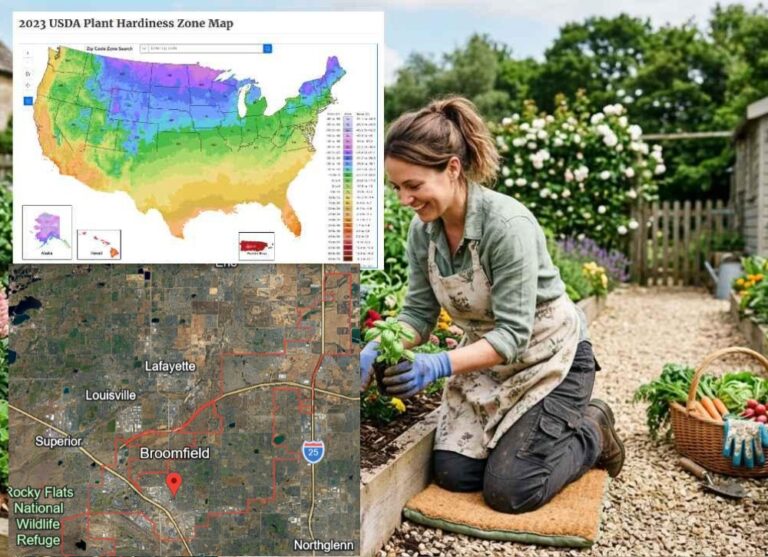
The 2023 USDA Plant Hardiness Zone Map places Broomfield in two zones: Zone 5b and Zone 6a.
Zone 6a covers the warmer, lower-elevation portions of the city, with average annual extreme minimum temperatures between -10°F and -5°F. Zone 5b applies to slightly cooler pockets, where minimums range from -15°F to -10°F.
Most residential neighborhoods in Broomfield fall within Zone 6a. The city sits at roughly 5,420 feet of elevation, similar to both Denver and Boulder, and its relatively flat terrain means there is less zone variation across town than you would find in a hillier area.
The 2023 USDA map was developed by the PRISM Climate Group at Oregon State University using weather data from 1991 to 2020. It replaced the previous 2012 edition, which relied on older data from 1976 to 2005 and placed many Front Range communities slightly cooler than the current map does.
What Zone 6a Means for Your Garden
Zone 6a is a cold-hardiness rating, not a complete climate profile. It tells you the lowest winter temperature your plants need to survive on an average year.
If a plant label says “Hardy to Zone 6,” it should make it through a Broomfield winter without dying back to the roots. A plant labeled Zone 7 or higher was bred for milder winters and will likely freeze out here.
The Limits of a Zone Number
A zone designation does not account for summer heat, rainfall patterns, soil conditions, or wind. In a place like Broomfield, all four of those factors influence plant survival almost as much as the winter low.
Broomfield receives about 15 inches of precipitation per year, which is well below what most ornamental plants from eastern nurseries expect. That dry air and intense high-altitude sunshine mean you cannot just shop by zone number alone. You also need plants adapted to semi-arid conditions. If foliage starts yellowing despite adequate watering, this guide on why your plant is turning yellow helps you diagnose the cause.
How Zone 5b and 6a Overlap in Broomfield
If your property sits in a low spot where cold air settles overnight, or if you are on the north side of a hill with less sun exposure, your yard may functionally behave like Zone 5b. Choosing plants rated for Zone 5 gives you extra insurance in these spots. For a deeper look at what Zone 5 conditions mean in practice, check out this overview of Zone 5 frost dates and growing season.
Yards with south-facing exposure, near heat-absorbing structures like brick walls or concrete patios, tend to perform more like Zone 6a or even nudge toward 6b conditions in sheltered corners. Reading your own yard’s microclimate matters more than the map color under your address.
Broomfield’s Growing Season and Frost Dates
Broomfield’s frost-free growing season runs approximately 151 to 168 days, depending on the data source and specific weather station used.
Frost data from plantingzonesbyzipcode.com puts the average last spring frost at May 7 and the first fall frost at October 4, yielding about 168 growing days. Dave’s Garden’s frost calculator shows a more conservative window, with reliable frost-free conditions from May 15 to September 19, totaling around 151 days.
The practical takeaway is this: plan for a last frost around early to mid-May and a first frost in late September to early October. That gives you roughly five months of active gardening.
Timing Warm-Season Crops
Tomatoes, peppers, squash, and beans should not go outside until after mid-May. Starting seeds indoors about six to eight weeks before your target transplant date lets you make the most of the growing window.
Soil temperature matters just as much as air temperature for warm-season crops. A soil thermometer is a small investment that prevents you from transplanting into ground that is still too cold for root growth.
Timing Cool-Season Crops
Peas, spinach, lettuce, kale, and radishes tolerate frost and can go into the ground as early as late March or early April in Broomfield, provided the soil is workable.
These crops also perform well as fall plantings. Sowing a second round in late July or early August gives you a harvest that extends into October, often producing better flavor than the spring crop because cooler night temperatures concentrate sugars. For a step-by-step guide to direct seeding, how to direct sow lettuce seeds covers technique and spacing.
Plants That Thrive in Broomfield’s Climate
Successful gardening in Broomfield means combining zone-appropriate cold hardiness with drought tolerance and an ability to handle alkaline, clay-rich soil.
Reliable Trees for Broomfield Yards
Broomfield’s neighborhoods support a solid range of shade and ornamental trees. These species have proven themselves locally:
- Bur oak handles cold, drought, and heavy clay without complaint
- Honeylocust provides filtered shade and tolerates urban conditions
- Kentucky coffeetree resists drought and most common pests
- Northern catalpa grows fast and produces showy flower clusters
- Crabapple varieties deliver spring blossoms and fall fruit
Perennials That Come Back Strong
Native and near-native perennials outperform imports in Broomfield’s conditions almost every time. Blanket flower, purple coneflower, and black-eyed Susan all pair cold hardiness with low water needs.
Russian sage fills large spaces with silvery foliage and purple blooms from midsummer into fall. It barely needs watering once established and laughs at Broomfield’s worst winter nights.
Catmint works well along walkways and borders, blooming repeatedly through the season if you trim it back after the first flush of flowers fades.
How Broomfield Compares to Nearby Cities
Broomfield’s zone profile matches the broader Denver metro pattern closely. Denver and Aurora both share the Zone 6a classification, which means plant recommendations from either city transfer well to Broomfield.
Boulder, located just to the northwest, leans more firmly into Zone 5b, especially in neighborhoods closer to the foothills. If you moved from Boulder to Broomfield, you may find that a slightly wider selection of plants survives winter in your new yard.
Castle Rock to the south sits in Zone 5b with a shorter growing season than Broomfield enjoys. And for a completely different Colorado gardening experience, Durango in the southwest has comparable winter warmth but a growing season of under 100 days.
Broomfield’s position in the metro corridor, surrounded by development and pavement, likely gives it a small urban heat advantage over these more spread-out communities.
Practical Tips for Gardening in Broomfield
Water newly planted trees and shrubs deeply once a week during their first two growing seasons. Established plants can shift to less frequent but still deep irrigation. Shallow daily watering encourages roots to stay near the surface, which makes them more vulnerable to winter cold and summer drought. For a broader watering guide, how often should you water your plants covers seasonal best practices.
Add two to three inches of mulch around beds and tree bases each fall. Mulch stabilizes soil temperature during winter freeze-thaw cycles, which cause more root damage in Broomfield than the cold alone. This is part of a larger fall routine covered in how to prepare your garden for winter.
Amend heavy clay soil with compost before planting anything. Broomfield’s native soil drains poorly and ties up nutrients at high pH levels. Working in three to four inches of quality compost at planting time improves both drainage and fertility.
Test your soil pH if you notice plants yellowing despite adequate water and fertilizer. Iron chlorosis is common on the Front Range because the high pH locks iron into forms that plant roots cannot absorb. Soil sulfur or chelated iron treatments can correct this, but knowing your starting pH saves you from guessing.
Group plants by water needs. Putting a xeric native next to a thirsty perennial means one of them always gets the wrong amount of water. Hydrozoning, which simply means clustering plants with similar irrigation requirements, is one of the easiest ways to improve results in Broomfield’s dry climate.
Garlic makes an excellent overwinter crop in Broomfield. Plant cloves in mid-October, cover them with a layer of mulch, and you will harvest bulbs the following July. For timing and technique, these five easy steps to plant garlic cover everything you need.