A planting zone tells you how cold your winters get and which trees, shrubs, and perennials can survive them. Gardeners rely on this number before they buy a single seed packet.
For someone living in Colorado Springs, this question carries extra weight. The city climbs from flat plains into rocky foothills, and that shift in elevation changes the climate block by block.
A gardener in one part of town can plant something that freezes solid a few miles away. That gap catches a lot of new residents off guard.
This guide walks through the exact zone, why it splits across the city, and how to pin down your own patch of ground with certainty.
- What Planting Zone Is Colorado Springs
- Zone Differences in Lower-Elevation Neighborhoods
- Zone Differences in Higher-Elevation and Foothill Areas
- Zone Differences in Outlying Areas (e.g., Black Forest, Broadmoor)
- How to Find Your Exact Planting Zone by Address or ZIP Code
- Understanding the USDA Hardiness Zone Map
- Frost Dates and Growing Season Length in Colorado Springs
- Plants That Grow Well in Colorado Springs’ Zone
- Why Knowing Your Exact Zone Matters for Colorado Springs Gardening Success
What Planting Zone Is Colorado Springs
Colorado Springs sits mainly in USDA Hardiness Zone 6a, with a good portion of the city falling into the cooler Zone 5b.
Zone 6a applies to most of Colorado Springs, including the downtown area, the westside, and southeast neighborhoods. This is the zone most residents in the central and lower parts of the city will land in.
Zone 5b covers higher-elevation spots such as the Air Force Academy area, Cave of the Winds, and parts of Briargate. These pockets sit noticeably higher and catch colder air more often.
The gap between these two zones comes down to about five degrees of extreme winter cold. Zone 6a dips to roughly negative ten degrees Fahrenheit in a harsh winter, while Zone 5b can drop closer to negative fifteen.
That five-degree swing decides whether a borderline shrub survives February or dies back to the roots.
Zone Differences in Lower-Elevation Neighborhoods
The lower, more central parts of Colorado Springs tend to hold onto a bit more warmth through winter. This is where Zone 6a shows up most consistently across the city.
Downtown, the westside, and pockets near the older city core sit at a lower elevation than the outer edges of town. Thinner cold air pools less easily in these spots.
Paved streets, buildings, and denser development also create a mild heat island effect. Concrete and asphalt hold onto daytime warmth and release it slowly overnight, nudging temperatures up just enough to matter.
Gardeners in these lower neighborhoods often get away with plants rated for Zone 6a without much winter protection. A shrub that struggles in Briargate can do just fine a few miles south in the older parts of town.
Zone Differences in Higher-Elevation and Foothill Areas
Move toward the western edge of the city, closer to the mountains, and the zone shifts colder. This is where Zone 5b takes over from Zone 6a.
Higher-elevation parts of the city fall in zone 5b due to proximity to the Rockies. Areas near the Air Force Academy and the foothill-adjacent northern neighborhoods sit firmly in this cooler band.
Elevation gain is the main driver here. As land climbs toward the foothills, the air thins and holds less heat overnight, which drags average winter lows down.
Wind exposure plays a role too. Foothill neighborhoods catch stronger, colder gusts sweeping off the mountains, which can knock a marginal plant back even when the thermometer alone looks survivable.
Gardeners in these higher pockets should shop for plants rated to Zone 5b or colder, even if a nursery tag lists Colorado Springs generally as 6a.
Zone Differences in Outlying Areas (e.g., Black Forest, Broadmoor)
Beyond the main elevation split, specific named areas around Colorado Springs carry their own quirks. Local terrain and tree cover shift conditions in ways a citywide zone number cannot capture.
Black Forest sits northeast of the city at a higher elevation, and its dense stand of ponderosa pines changes the local microclimate. The tree cover traps cold air in low spots on clear nights, sometimes pushing temperatures a notch colder than the open plains nearby.
The Broadmoor area, tucked closer to the mountains on the city’s southwest side, benefits from some shelter against harsh winds while still sitting at a higher elevation than downtown. This mix can create milder pockets even within a generally cooler zone band.
These local quirks mean two addresses just a few miles apart, both technically in the same broad zone, can behave quite differently in a hard freeze.
Anyone gardening in a well-known outlying pocket should treat the citywide zone as a starting point, not a final answer.
How to Find Your Exact Planting Zone by Address or ZIP Code
Given how much Colorado Springs varies from one neighborhood to the next, checking your specific zone is worth the two minutes it takes.
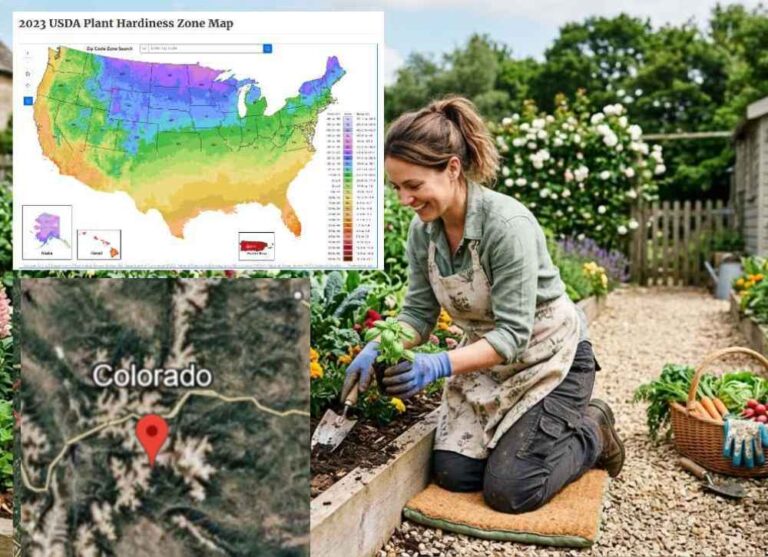
The official USDA Plant Hardiness Zone Map lets you type in your ZIP code and see the exact zone assigned to your area. This tool pulls directly from the federal government’s own climate data.
Here is how to use it in a few quick steps:
- Open the USDA zone map site and locate the ZIP code search box on the page.
- Type in your five-digit ZIP code and submit the search.
- Read the zone result shown, such as 5b or 6a, for your exact location.
- Click into the interactive map for a closer, street-level view if needed.
Because Colorado Springs spans two zones, checking by ZIP code matters more here than it would in a city with one uniform rating. A ZIP code covering a foothill neighborhood will return a different result than one covering downtown.
Understanding the USDA Hardiness Zone Map
The USDA Hardiness Zone Map is a tool built to show how cold winters typically get across different parts of the country. It splits the United States into numbered zones based on average annual minimum temperatures.
The zones were created using mean extreme climate data covering the period from 1991 to 2020, replacing an older version built on data from 1976 through 2005. This newer data reflects decades of gradual warming across many regions.
Each whole number zone spans a ten-degree range, and the letters a and b split that range into two five-degree halves. Zone 5b, for instance, sits five degrees warmer at its coldest point than Zone 5a.
The map itself was developed by the PRISM Climate Group at Oregon State University, using scientific algorithms that factor in elevation, terrain, and closeness to water. That is exactly why a mountain-adjacent city like Colorado Springs ends up split across more than one zone.
Frost Dates and Growing Season Length in Colorado Springs
Your planting zone tells you about winter survival, but frost dates tell you when it is actually safe to plant and harvest. Colorado Springs gardeners need both pieces of information.
By late May, there is roughly a ninety percent chance the city has seen its last night dipping to freezing temperatures. Early May still carries real risk, which is why most gardeners hold off on tender crops until closer to that point.
Fall works in reverse, with the first freeze typically arriving in early-to-mid October as nights cool down. The stretch between these two dates forms the local growing season.
Front Range cities in this elevation band typically see a growing season running somewhere between 130 and 165 days, depending on the exact spot. Higher, colder neighborhoods on the shorter end of that range need faster-maturing varieties.
Frost can still form on a clear, still night even when the air temperature reads a few degrees above freezing, since surfaces lose heat straight up into the sky. This is why Colorado Springs gardeners often watch the weekly forecast closely even after the average last frost date has passed.
Plants That Grow Well in Colorado Springs’ Zone
Once you know whether your patch of ground sits in Zone 5b or 6a, plant shopping gets much simpler. Look for the zone number printed on plant tags and seed packets, and match it to your own.
Both zones common to Colorado Springs share a short list of categories that reliably handle the winter cold and dry air here.
Perennials
- Sedum and other succulent-type perennials handle drought and cold with little fuss.
- Russian sage tolerates poor soil and thrives in the region’s intense sunshine.
- Coneflower and black-eyed Susan return reliably year after year in both zones.
Vegetables
- Cool-season crops like spinach, peas, and carrots handle a late spring chill well.
- Potatoes and root vegetables mature within the shorter growing window here.
- Fast-maturing tomato varieties suit the compressed frost-free season better than slow ones.
Trees and Shrubs
- Bosnian pine handles the coldest Zone 5b pockets without winter damage.
- River birch adapts well across both zones found in the city.
- Native junipers and serviceberry tolerate wind, drought, and cold with minimal care.
Why Knowing Your Exact Zone Matters for Colorado Springs Gardening Success
Colorado Springs is not one climate. It is several, layered across elevation changes, packed into a single city.
A plant rated safely for Zone 6a might die back completely if planted in a Briargate yard sitting in Zone 5b instead. That single mismatch can waste a season of work and money.
Checking your precise zone by address, rather than trusting a general citywide answer, protects against that mistake before you ever dig a hole. Pairing that zone number with accurate local frost dates rounds out the full picture.
Every section here points to the same conclusion: elevation drives everything in this city’s gardens. Know your exact spot on that elevation map, and the rest of your planting decisions fall into place with far less guesswork.AC