Every gardener who picks up a seed packet eventually hits the same wall: what zone am I actually standing in?
That question matters more in a town like Westport, Massachusetts, than in most places. The town stretches from quiet inland woods to open salt water, and temperatures shift from block to block along the way.
Guess wrong, and the risk shows up fast. A shrub rated for a warmer zone can freeze solid in January, and a whole season of work dies with it.
This guide breaks Westport down by its actual neighborhoods, walks through frost dates, and points to plants built for the local cold. By the end, you will know exactly where your yard fits.
- What Planting Zone Is Westport, MA, In
- North Westport and Inland Areas
- Central Village and Head of Westport
- Westport Point, Westport Harbor, and Acoaxet (Coastal Areas)
- Westport, MA USDA Hardiness Zone Map
- How to Find Your Planting Zone by Zip Code
- Westport, MA First and Last Frost Dates
- Best Plants for Zone 7a Massachusetts
- USDA Zone Map 2012 vs 2023 Changes
- Why Knowing Westport’s Exact Zone Sub-Area Matters Most
What Planting Zone Is Westport, MA, In
Westport, Massachusetts, sits in USDA Hardiness Zone 7a, based on the 2023 USDA Plant Hardiness Zone Map. Zone 7a covers spots where winter lows average between 0°F and 5°F.
That single number is the backbone of everything else in this guide. Every plant list, every frost date, and every sub-area breakdown that follows builds on this base reading.
For a wider look at how Westport fits into the state as a whole, see our full breakdown of what planting zone Massachusetts falls under.
Still, a town-wide zone only tells part of the story. Westport covers a lot of ground, and the sections ahead show how location within the town can slightly shift that reading.
North Westport and Inland Areas
North Westport sits furthest from the ocean, tucked among woods, ponds, and rolling farmland. Without water nearby to hold onto heat, this part of town runs colder in winter than the coast.
North Westport still falls within zone 7a on the current map, matching the town-wide reading. But it sits closer to the cold edge of that zone than areas nearer the shore.
Gardeners here should treat winter lows on the tougher end of the 0°F to 5°F range. A plant that barely survives near the water may struggle more in these inland pockets.
Wind also plays a bigger role away from the coast. Open fields and higher ground let cold air settle and linger, so frost can arrive earlier here than elsewhere in town.
For more on how location shapes hardiness across the region, browse our regional gardening zone guides.
Central Village and Head of Westport
Central Village and the Head of Westport sit roughly in the middle of town, between the cooler inland stretch and the milder coast. This middle position gives the area a fairly balanced winter climate.
Both spots fall within zone 7a, consistent with the rest of Westport. They avoid the harsher chill found further north while still missing the strongest ocean warmth felt near the harbor.
For everyday planning, gardeners in these central areas can follow standard Zone 7a guidance without much adjustment. Frost timing here tends to land close to the town average described later in this piece.
Westport Point, Westport Harbor, and Acoaxet (Coastal Areas)
Westport Point, Westport Harbor, and Acoaxet sit right along Buzzards Bay and Rhode Island Sound. Ocean water holds heat far longer than land, and that heat slowly bleeds into the surrounding air through winter.
This coastal buffering means these villages often see slightly milder winter nights than inland Westport, even while both sides of town share the same zone 7a label on the current map.
The effect is strongest in midwinter, when a cold snap inland might dip a few degrees lower than the same night near the water. Gardeners here sometimes push plant hardiness limits with modest success.
That said, coastal areas trade one risk for another. Salt spray and strong winter winds off the water can stress certain plants, even when temperatures themselves stay comparatively gentle.
The same ocean effect shows up further south too, as covered in our guide to what planting zone Cape Cod, Massachusetts, is in.
Westport, MA USDA Hardiness Zone Map
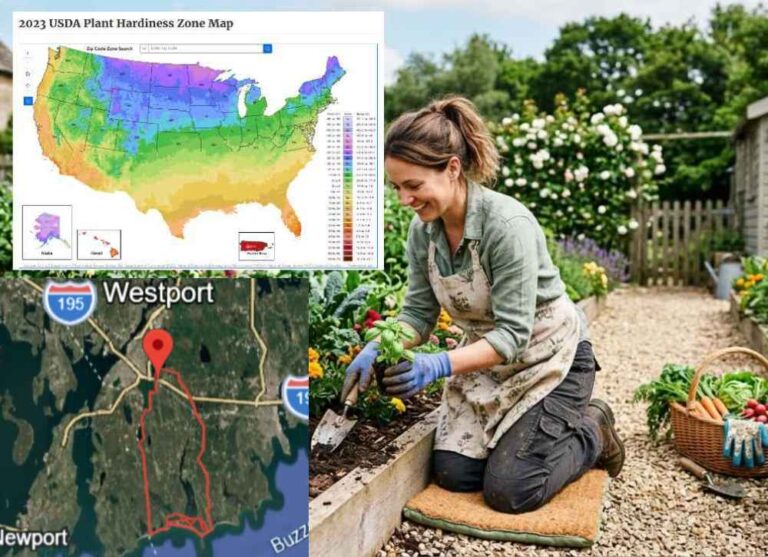
The clearest way to confirm your exact spot is to look at the official 2023 USDA Plant Hardiness Zone Map directly. It shows zone boundaries down to a fine level of detail, not just a single town-wide average.
Because Westport straddles the edge between zones on some maps, checking your precise address matters more than relying on a general town label. A property near a zone line can sit just inside 7a or just outside it.
You can view the interactive version of the USDA Plant Hardiness Zone Map and zoom directly into your street. Clicking anywhere on the map brings up the zone reading for that exact point.
Once you find your spot, note whether it sits near a color boundary. If your property lies close to a dividing line, it helps to plan for the cooler of the two zones just to be safe.
Curious how Westport compares to the rest of the state? Check out what planting zone Boston is in for another coastal Massachusetts reference point.
How to Find Your Planting Zone by Zip Code
Westport uses two ZIP codes, 02790 and 02791, and both fall within the town’s zone 7a designation. Searching by ZIP code gives a faster, more precise reading than searching by town name alone.
To check your own address, follow these steps:
- Open the USDA map tool or a ZIP-based hardiness lookup site.
- Enter 02790 or 02791, whichever matches your mailing address.
- Review the zone result shown for that ZIP boundary.
- Cross-check your street against the map’s zoom view if you sit near a border.
- Note the result for reference when buying plants or seeds.
ZIP-based tools pull from the same 2023 climate data as the full USDA map, so results should match what you find when browsing the map by hand. The ZIP method just gets you there faster.
Keep in mind that a ZIP code can still stretch across more than one microclimate. If your home sits near the edge of 02790 or 02791, the map view remains the more exact check.
Westport, MA First and Last Frost Dates
Frost dates mark the safe window for planting inside zone 7a, and they matter just as much as the zone number itself. Planting too early risks losing tender seedlings to a late cold snap.
Based on climate averages from the nearest official weather station, drawn from NOAA’s 1991 to 2020 climate data, the last spring frost in this part of coastal Massachusetts tends to land around late April.
The first fall frost typically arrives around early November, giving the area a fairly long frost-free stretch compared to inland Massachusetts towns further from the water. That gap between the last and first frost defines your safe growing season.
For most vegetables and tender annuals, planting after the spring date and harvesting before the fall date keeps risk low. Coastal pockets like Westport Point may push both dates slightly later in the fall and earlier in spring.
As the first fall frost gets closer, our guide on how to prepare your garden for winter walks through the steps worth taking beforehand.
Best Plants for Zone 7a Massachusetts
Zone 7a plants need to handle winter lows down to 0°F without dying back completely. Westport’s mix of coastal and inland conditions still fits comfortably within that broader category.
The lists below cover reliable choices across three common garden categories. Each one is suited to the cold range Westport experiences most winters.
Perennials That Handle the Cold Without Fuss
- Coneflower, tough against both cold snaps and dry spells.
- Black-eyed Susan blooms reliably through late summer heat.
- Daylily spreads easily and survives most winter conditions.
- Russian sage thrives in coastal wind and poor soil.
- Sedum stores water and shrugs off frost damage.
Shrubs Built for Coastal and Inland Winters
- Inkberry holly holds up well against salty coastal air.
- Winterberry, a native shrub that tolerates wet Westport soils.
- Bayberry, naturally suited to sandy, windswept New England ground.
- Rhododendron, reliable bloomer across most of zone 7a.
- Hydrangea, a popular Massachusetts staple that handles winter lows fine.
Vegetables Worth Planting Once Frost Risk Passes
- Tomatoes, best started indoors before the last frost date.
- Peppers need warm soil after spring frost fully clears.
- Winter squash, thrives through Westport’s long fall growing window.
- Kale tolerates light frost and improves in cooler weather.
- Garlic, planted in the fall for a summer harvest the next year.
USDA Zone Map 2012 vs 2023 Changes
Westport shifted from zone 6b on the 2012 USDA map to zone 7a on the current 2023 version. That change reflects updated climate data covering the years 1991 through 2020.
According to hardiness zone data compiled by the plant mapping site Plantmaps, this shift shows up across much of coastal southeastern Massachusetts, not just Westport alone.
For gardeners, the practical result is a slightly wider plant selection than the 2012 map would have suggested. Some shrubs and perennials once considered borderline risky now sit comfortably within the accepted zone.
That said, one warmer map does not erase the chance of an unusually harsh winter. Treat the zone 7a rating as a helpful average, not a guarantee against every cold snap.
Why Knowing Westport’s Exact Zone Sub-Area Matters Most
A single “Westport is zone 7a” answer is accurate, but it only tells part of the story. The real value comes from knowing which corner of town your own yard sits in.
Inland North Westport, the central village areas, and the coastal villages near the water all share the same zone 7a label, yet each one leans toward a different edge of that range.
That difference can decide whether a borderline plant survives its first hard winter. A shrub that thrives near Westport Harbor might struggle further inland, even within the same official zone.
Use zone 7a as your starting baseline, then adjust based on exactly where your property sits within town. That combination gives a far more reliable answer than the zone number alone.
Looking to compare notes with a neighboring town? Our guide to what planting zone Plymouth, MA is in covers another spot along the same coastline.