Seekonk gardeners run into the same hurdle every spring. You pick up a plant tag with a zone number on it, and that number means nothing until you’ve matched it to your own yard.
Getting this wrong has real consequences. A shrub or perennial suited for a warmer winter than Seekonk actually gives can weaken or die once the cold arrives.
Seekonk also isn’t uniform from one end of town to the other. Farmland near the rivers, sheltered spots near the Rhode Island line, and open low ground can each run colder or warmer than the town’s general reading suggests.
This guide breaks down Seekonk’s official zone, the local quirks that shift it street by street, and which plants are worth planting once you know where you stand. For a wider view, see our guide on what planting zone Massachusetts falls under.
- What Planting Zone Is Seekonk, MA
- Seekonk’s Official USDA Hardiness Zone Classification
- How Elevation Changes the Zone Within Seekonk
- Riverside and Farmland Areas Near the Runnins and Palmer Rivers
- Areas Near the Rhode Island Border and Developed Sections
- How to Find Your Exact Planting Zone by Zip Code
- Understanding the USDA Hardiness Zone Map
- Seekonk, MA First and Last Frost Dates
- Best Plants for Seekonk’s Growing Zone
- Putting Seekonk’s Zone Knowledge Into Practice
What Planting Zone Is Seekonk, MA
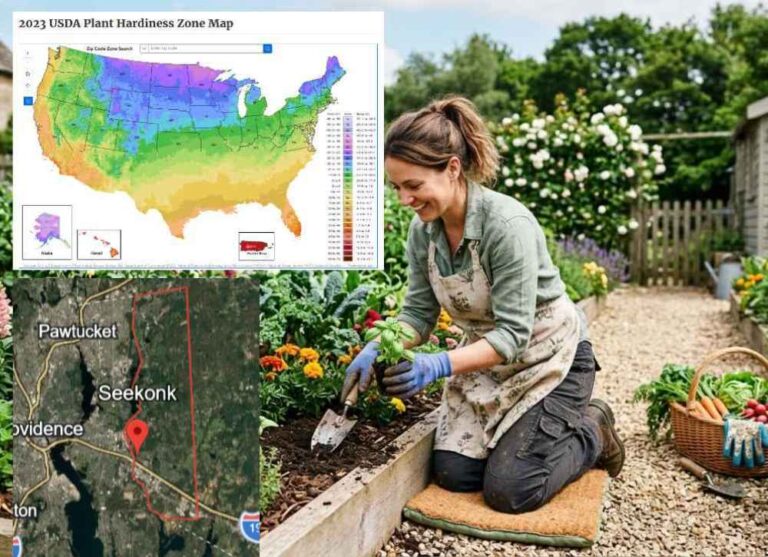
Seekonk sits within USDA Hardiness Zone 7a, with parts of town reading as the slightly cooler Zone 6b.
That range puts typical winter lows somewhere between negative 5 and 5 degrees Fahrenheit, depending on the exact section of town.
This comes directly from the USDA’s own climate monitoring system, not a private estimate.
Knowing this number is the first real step toward choosing plants built to handle what Seekonk’s winters actually deliver.
Seekonk’s Official USDA Hardiness Zone Classification
Per Plantmaps’ reading of the 2023 USDA Hardiness Zone Map, the North Seekonk area falls into both Zone 6b and Zone 7a.
Zone 6b covers average winter lows from negative 5 to 0 degrees, while Zone 7a runs from 0 up to 5 degrees.
This places Seekonk among the milder parts of Massachusetts, since much of the state’s interior sits a full zone or more colder.
The town’s zone reflects its position in the far southeastern corner of the state, close to the coast and the Rhode Island border, where winters run gentler than inland Massachusetts.
That reading comes from climate data spanning 1991 through 2020, the same data set behind the broader 2023 map update. Neighboring Massachusetts towns closer to Boston generally sit a touch cooler than Seekonk’s southeastern position.
How Elevation Changes the Zone Within Seekonk
Seekonk’s terrain isn’t dramatic, but small differences in elevation and shelter still shift how cold a given yard gets overnight.
Higher ground and spots shielded from open wind tend to hold onto more warmth than exposed, low-lying land nearby.
Neighborhoods on slightly higher or more sheltered ground often land closer to the milder Zone 7a reading.
Open, exposed low ground tends to drop toward the cooler Zone 6b range instead, even within the same town.
Gardeners on exposed lots should treat borderline perennials with a bit more caution than someone gardening on higher, more sheltered ground.
Riverside and Farmland Areas Near the Runnins and Palmer Rivers
Land close to the Runnins and Palmer Rivers, along with Seekonk’s open farmland, behaves differently from higher, drier ground elsewhere in town.
Cold air is heavier than warm air, so it drains downhill and settles into low fields and riverbanks overnight.
This creates frost pockets, spots where frost shows up even on nights when nearby higher ground stays clear.
Frost also tends to linger later into spring near these low, damp stretches, which can delay when it’s safe to set out tender plants. Watching for obvious signs your plant needs water matters even more in these slower-to-warm, riverside spots.
Gardeners working farmland near the Runnins or Palmer should expect a shorter frost-free window than the rest of town, tilting these areas toward the colder edge of Zone 6b.
Areas Near the Rhode Island Border and Developed Sections
Seekonk’s busier commercial corridors and more paved sections near the Rhode Island line hold onto daytime heat and release it slowly after dark.
This heat retention effect keeps these developed pockets a few degrees warmer overnight than open, rural stretches of town.
That difference can push a built-up area toward the milder end of Zone 7a, even while nearby open land reads as Zone 6b.
Gardeners with smaller lots in these denser sections sometimes find borderline plants hold up better there than the same plants would in open farmland.
How to Find Your Exact Planting Zone by Zip Code
Since Seekonk spans more than one zone, checking your specific address is the only reliable way to know where your yard falls.
Visit the official USDA Plant Hardiness Zone Map and enter your Seekonk zip code into the search box.
The tool will return your precise zone along with the average winter low tied to that exact location.
If your property sits near a river, in open farmland, or close to the Rhode Island border, treat that result as a solid starting point rather than the final word.
Checking in with a local nursery or a longtime neighbor can help confirm what the lookup tool tells you.
Understanding the USDA Hardiness Zone Map
The USDA Hardiness Zone Map tracks one specific measurement: the average coldest temperature a location experiences each winter.
That number gets grouped into zones, each spanning 10 degrees, and further split into “a” and “b” half zones covering 5 degrees apiece.
The USDA first released a version of this map back in the 1920s, and it’s only been updated a handful of times since, most recently in 2023.
Nurseries, seed catalogs, and plant tags all lean on this same system, which is exactly why matching your zone to a plant’s rating matters before you buy anything. Our regional gardening guide covers how these shifts have played out for other New England towns too.
Seekonk, MA First and Last Frost Dates
Seekonk’s average last spring frost typically falls somewhere in the last week of April through the first half of May, based on regional frost tracking for the area.
The average first fall frost tends to arrive in mid-to-late October, reflecting the milder conditions found this close to the coast and the Rhode Island line.
That gives Seekonk a fairly generous growing window compared to inland Massachusetts towns.
Planting warm-season crops before that spring frost window closes risks losing young plants to a late cold snap. Our spring planting guide covers how to time that window without rushing it.
Waiting too long into fall carries the opposite risk, where an early cold snap can end a harvest before it finishes, something our fall planting guide walks through in more depth.
Best Plants for Seekonk’s Growing Zone
Seekonk’s Zone 6b and 7a range supports a wide variety of vegetables, flowers, shrubs, and trees, given the town’s relatively mild winters for Massachusetts.
Vegetables that do well here include:
- Tomatoes, peppers, and cucumbers started once the last spring frost had cleared.
- Lettuce and spinach, both suited to Seekonk’s cooler spring and fall stretches.
- Garlic, planted in fall for a harvest the following summer
- Winter squash and pumpkins, which benefit from the zone’s longer frost-free window
Flowers and shrubs suited to this zone include:
- Hydrangeas, which thrive in Zone 6b and 7a conditions without extra winter protection
- Camellias, a shrub that does well in Seekonk’s milder pockets but struggles further inland
- Daylilies, tolerant of both the zone’s winters and its warmer summer stretches
- Roses, which generally perform reliably across both of Seekonk’s zone readings
Trees that hold up well here include red maple, flowering dogwood, and Japanese maple, all suited to the milder end of the Massachusetts hardiness range. Whatever you choose, a steady watering routine matters just as much as the zone rating early on; our plant watering guide covers how often young plants actually need it.
Putting Seekonk’s Zone Knowledge Into Practice
Seekonk sits mainly in Zone 7a, with cooler Zone 6b pockets in low-lying farmland and near the town’s rivers.
Confirm your specific reading using the official zip code lookup tool, then weigh whether your yard sits near a river, in open farmland, or closer to the more developed Rhode Island border area.
Plan your planting around Seekonk’s typical frost window, roughly late April through mid-to-late October, and lean toward vegetables, shrubs, and trees proven to handle both of the town’s zones.
Use the zone number as your starting point, then adjust based on what your own yard shows you season after season. Heading into the colder months, our winter garden prep guide covers how to protect what you’ve planted through Seekonk’s coldest stretch.