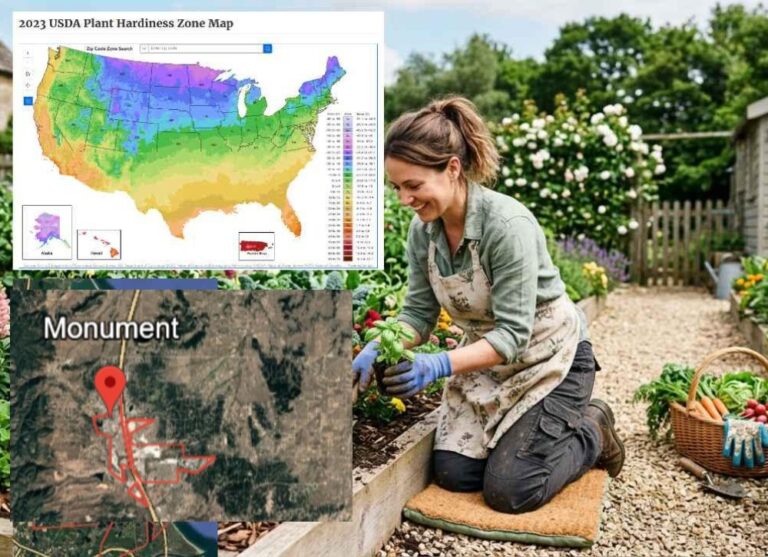
Monument sits north of Colorado Springs at an elevation near 7,000 feet, and that altitude changes everything about gardening here. Temperatures drop faster in the evening, wind blows harder across the open terrain, and the growing season shrinks compared to cities just a short drive south.
Choosing plants without knowing your USDA zone is a fast way to lose money at the nursery. A shrub that thrives in downtown Colorado Springs might freeze out completely in a Monument backyard, simply because of the elevation gap between the two cities.
This post covers Monument’s exact zone, what it means for your garden, and how to work with the local climate instead of against it.
Monument Is Classified as USDA Zone 5b
According to the 2023 USDA Plant Hardiness Zone Map, Monument, Colorado falls in Zone 5b. The average annual extreme minimum winter temperature here ranges from -15°F to -10°F.
This classification remained unchanged from the 2012 version of the USDA map, as confirmed by Plantmaps.com. While many Colorado cities shifted half a zone warmer in the 2023 update, Monument’s higher elevation kept it firmly in 5b.
The data behind this map comes from 30 years of climate records (1991 to 2020), processed by the PRISM Climate Group at Oregon State University.
What Zone 5b Means in Monument
Zone 5b is a cold-hardiness threshold. It tells you that any plant you want to grow outdoors year-round in Monument needs to tolerate lows of at least -15°F.
Trees, shrubs, and perennials labeled “Zone 5” on the nursery tag should survive here. Anything rated “Zone 6 and above” carries serious risk during a harsh winter, especially in Monument’s exposed, windy terrain.
Elevation Makes Monument Colder Than Its Neighbors
Monument sits roughly 1,500 feet higher than downtown Colorado Springs, which straddles Zones 5b and 6a. That elevation bump translates into colder nighttime temperatures, more frost events per year, and a shorter frost-free window.
A report from the Colorado Springs Gazette noted that the Colorado Springs and Monument areas range from Zone 4b to 5b on the USDA map, depending on exact location. Monument’s open landscape and proximity to the Palmer Divide make its microclimate one of the cooler spots along the I-25 corridor.
Wind and Sun Compound the Cold
The zone number does not capture wind chill or UV intensity. Monument gets strong, persistent winds that dry out soil and desiccate evergreen foliage in winter. The altitude also brings stronger UV radiation, which can sunscald young tree bark and stress shallow-rooted plants.
These factors mean that even plants rated for Zone 5 sometimes struggle in Monument if they are not positioned in a sheltered spot with some wind protection.
Frost Dates and Growing Season
For vegetable gardening, frost dates are more important than the zone number. Monument’s growing season is noticeably shorter than lower-elevation cities nearby.
According to KOAA News, Monument typically does not see its final spring freeze until mid-May. The first fall frost can arrive by late September. That leaves roughly 120 to 130 frost-free days in a typical year.
If you want to grow tomatoes, peppers, or other warm-season crops, starting seeds indoors by early March is almost mandatory. You can review the specifics on when to plant tomatoes in Zone 5 for timing that applies directly to Monument.
The zone 5 frost dates and growing season guide provides a broader look at what this compressed window means for planting schedules.
What Grows Well in Monument
Monument’s cold winters and dry summers narrow the plant palette compared to Denver or the Western Slope, but there is still a solid range of options for both edible and ornamental gardens.
Vegetables That Perform in Zone 5b
Cool-season crops are your best allies in Monument. Lettuce, spinach, kale, radishes, and peas can go into the ground in mid-April. They tolerate frost and actually prefer cooler air temperatures. For a detailed schedule, see when to plant lettuce in Zone 5.
Warm-season vegetables like beans, squash, cucumbers, and corn need to wait until late May or early June. The soil stays cold at this elevation well past the point where the air feels warm enough.
Garlic is another strong choice for Monument. The ideal planting window for garlic in Zone 5 falls in September or October, with harvest the following July.
Trees and Perennials for the Palmer Divide
Cold-hardy fruit trees like apple, tart cherry, and some pear varieties do well in Monument if planted in a protected location. The key is avoiding exposed sites where wind and late frost can damage blossoms.
For ornamentals, look at Colorado blue spruce, Austrian pine, and native Gambel oak. Among perennials, blanket flower, penstemon, catmint, and native grasses like little bluestem handle both the cold and the wind without complaint.
Avoid anything that needs consistently moist soil or shelter from wind. Hydrangeas, Japanese maples, and most rhododendrons struggle at this elevation and exposure level.
How Monument Compares to Nearby Cities
Monument’s Zone 5b sits one half-zone colder than Colorado Springs, which reaches Zone 6a in its lower neighborhoods. That half-zone gap matters: it opens up certain marginally hardy plants in the Springs that simply will not survive Monument winters.
Heading north to Castle Rock, you find a similar 5b to 6a split depending on elevation. Further north, Denver sits fully in Zone 6a, about one full degree warmer in terms of winter minimums.
South of the Springs, the Arkansas River valley around Pueblo drops into Zone 6b, with milder winters and a longer growing season. The contrast between Monument and Pueblo is one of the starkest along Colorado’s Front Range.
Tips for Gardening at Monument’s Elevation
A few practical strategies help Monument gardeners overcome the challenges that altitude and wind create.
Build windbreaks on the north and west sides of your garden. Fences, hedge rows, or even temporary burlap screens reduce wind stress on plants and help the soil retain moisture longer.
Mulch heavily before winter. A thick layer of wood chips or straw protects root systems from the deep freezes that come with Zone 5b. More details on how to prepare your garden for winter walk you through the full process.
Use raised beds or containers for warm-season vegetables. Elevated soil warms faster in spring than ground-level beds, which gives your tomatoes and peppers a few extra days of heat accumulation. That small advantage matters when you only have about 120 frost-free days to work with.
Water with intention. Monument’s low rainfall and fast-draining soil mean that consistent, deep watering is critical during the growing months. Check how often to water your plants to find a rhythm that fits this dry, high-altitude environment.
Final Thoughts
Monument, Colorado sits in USDA Hardiness Zone 5b, with average winter lows between -15°F and -10°F. Its elevation near 7,000 feet shortens the growing season and amplifies the effects of wind and UV compared to nearby lower-elevation cities.
That zone classification is your baseline for selecting plants that will last here. Combine it with Monument’s frost dates, dry conditions, and exposure to wind, and you have a realistic picture of what it takes to garden successfully on the Palmer Divide.