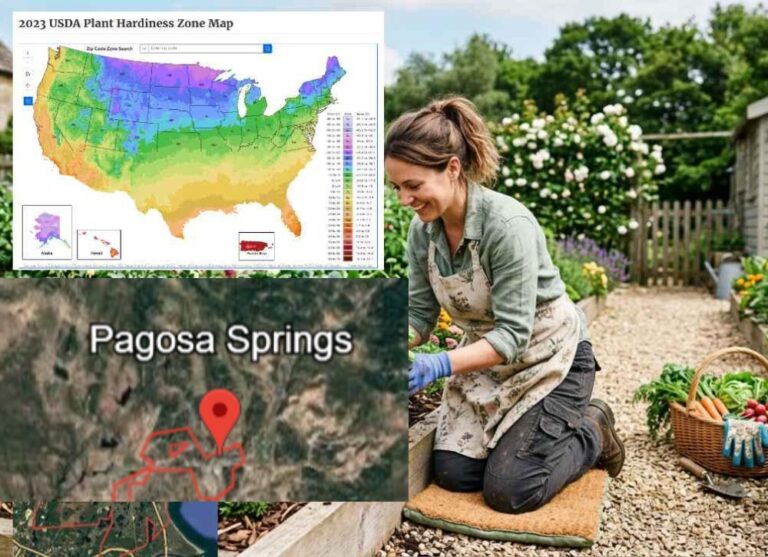
Pagosa Springs sits at 7,126 feet in the San Juan Mountains of southwestern Colorado, surrounded by national forest and a patchwork of alpine meadows, sage flats, and montane forests. It is one of the most beautiful places to live in the state, and also one of the hardest places to garden.
The growing season here is brutally short. Cold air pools in the valley at night, frost can strike in any month outside of July and August, and the window for warm-season vegetables barely gives you enough time to grow a ripe tomato. Without knowing your planting zone, you will almost certainly choose the wrong plants or plant them at the wrong time.
This guide explains exactly where Pagosa Springs falls on the USDA zone map, why its growing conditions are unusually tough, and how local gardeners still manage to grow food and beautiful landscapes at this altitude.
Pagosa Springs Falls in USDA Zone 5b to 6a
The 2023 USDA Plant Hardiness Zone Map places Pagosa Springs in Zones 5b and 6a, depending on exact location within the area.
Zone 5b means average annual extreme minimum temperatures of -15°F to -10°F. Zone 6a means lows of -10°F to -5°F. Properties in the valley floor and in low-lying frost pockets tend to fall on the colder 5b side, while homes on south-facing slopes or near the town’s geothermal hot springs can sit closer to 6a.
Garden.org’s zone lookup for the Pagosa Springs zip code (81147) also confirms a Zone 6a classification. Pagosa Peak Open School, a local educational institution, has noted that the area falls closer to Zone 5a in practice for some gardeners, depending on specific microclimate.
For planning purposes, Zone 5b is the safest baseline for most Pagosa Springs gardeners.
What Makes Pagosa Springs So Challenging
The zone number alone does not tell the full story. Pagosa Springs has several overlapping climate factors that make it tougher than a typical Zone 5b city at lower altitude.
An Extremely Short Frost-Free Window
According to data from Garden.org, Pagosa Springs averages only about 60 frost-free days per year, running roughly from early July to early September. That is among the shortest growing seasons of any populated area in Colorado.
Local gardening resources from Pagosa Peak Open School place the average last frost date around May 15 and the first fall frost around October 15, which gives a longer window on paper. But the Garden.org data accounts for a stricter frost threshold and the valley’s cold-air pooling effect, which pushes effective frost-free nights much later into spring.
Either way, this is a tight window. Most standard tomato, pepper, or melon varieties need 75 to 100 days to produce fruit, and Pagosa Springs often cannot deliver that many warm nights in a row.
Cold Nights Even in Summer
Nighttime temperatures regularly dip into the low 50s and upper 40s during July and August in Pagosa Springs. Ron Chacey, a local gardening expert, noted in a 2023 guide published through the Archuleta County Extension that warmth-loving plants like tomatoes, peppers, and cucumbers often struggle here because roots stay cold and plant metabolism slows during those cool nights.
This means the zone number and the frost dates only tell part of the story. Even within the frost-free window, growth is slower than what gardeners at lower elevations experience.
High-Altitude Sun and Dry Air
At over 7,100 feet, UV radiation is intense. Leaves can sunburn, and soil dries out rapidly. Annual rainfall is modest, and much of it comes in brief summer thunderstorms that do not always soak the ground deeply enough for garden plants.
What Grows Well in Pagosa Springs
Despite the short season, Pagosa Springs gardeners can produce food and grow attractive landscapes. The key is picking the right crops and using season-extension tools.
Vegetables That Fit the Short Season
Cool-season crops are the backbone of any Pagosa Springs vegetable garden. Lettuce, spinach, kale, radishes, peas, and beets all tolerate frost and grow quickly enough to produce within the limited window. You can review the timing for lettuce in Zone 5 as a reference point.
Root vegetables like carrots, turnips, and potatoes also perform well. They handle cool soil better than fruiting crops and can stay in the ground through light fall frosts.
For warm-season crops, choose short-maturity varieties. A tomato that takes 55 to 65 days to ripen has a much better shot here than one that needs 85 or more days. Starting seeds indoors by late March or early April is essential. General guidance on tomato planting in Zone 5 helps with the indoor seed-starting schedule.
Garlic does surprisingly well in the mountains. Plant cloves in fall as recommended for Zone 5 and let them overwinter. They will be ready to harvest the following summer.
Trees and Perennials for Mountain Conditions
Cold-hardy trees like aspen, Colorado blue spruce, ponderosa pine, and Engelmann spruce are natural fits for Pagosa Springs. Among fruit-bearing trees, cold-hardy apple varieties (like Honeycrisp or Haralson) and tart cherries have the best odds, though late-spring frost on blossoms remains a risk.
Native perennials are the smartest ornamental choice. Columbine, penstemon, yarrow, and blanket flower all tolerate Zone 5b cold, dry summers, and rocky mountain soil without much fuss.
Avoid Zone 6 or higher ornamentals unless you can provide winter protection. Most roses beyond the rugosa and Explorer types, for example, will not survive reliably at this altitude.
Season Extension Strategies That Work Here
Because Pagosa Springs’ outdoor growing season is so compressed, many successful gardeners here rely on structures and tools to add weeks or even months to their production.
Greenhouses and High Tunnels
Greenhouses are common in Pagosa Springs. Pagosa Peak Open School uses GGP dome greenhouses to teach year-round gardening at altitude. These enclosed structures trap heat during the day and buffer against frost at night, extending the usable season by several months.
Even a small hobby greenhouse or plastic-covered high tunnel can turn a 60-day outdoor season into a 150-day protected growing season.
Row Covers and Raised Beds
Floating row covers add a few degrees of frost protection and are simple to install. They let Pagosa Springs gardeners transplant warm-season crops two to three weeks earlier than open-ground planting would allow.
Raised beds warm up faster in spring because the soil sits above the cold ground. This is especially helpful in Pagosa, where ground-level soil stays cold well into June. Understanding the key factors that affect planting time can help you decide when raised beds are ready for transplants.
How Pagosa Springs Compares to Other Colorado Cities
Pagosa Springs’ 5b/6a split is similar in number to cities like Fort Collins and Boulder, but the growing experience is dramatically different. Fort Collins at 5,000 feet gets 129 frost-free days. Pagosa Springs at 7,100 feet may get half that.
The zone number only captures winter minimums. It does not account for the overall coolness of summer nights, the altitude-driven UV exposure, or the cold-air pooling that chops Pagosa’s effective growing season far below what the zone alone would predict.
Compared to other mountain towns, Pagosa Springs is milder than places like Leadville or Breckenridge (Zones 4a to 4b), but it is still a fundamentally different gardening environment from Front Range cities like Denver or Colorado Springs.
Nearby Durango sits at a slightly lower elevation and benefits from a bit more warmth, though it faces many of the same mountain-gardening challenges.
Final Thoughts
Pagosa Springs, Colorado falls in USDA Zones 5b to 6a, with average winter lows between -15°F and -5°F. Its elevation above 7,100 feet compresses the growing season to as few as 60 frost-free days, making it one of the most demanding gardening locations in the state.
But demanding does not mean impossible. Cool-season vegetables, cold-hardy perennials, and season-extension tools like greenhouses and row covers allow Pagosa gardeners to grow food and beautiful landscapes in spite of the altitude. The trick is accepting the zone for what it is, planning around the frost window, and letting the mountain climate guide your choices rather than fighting it.