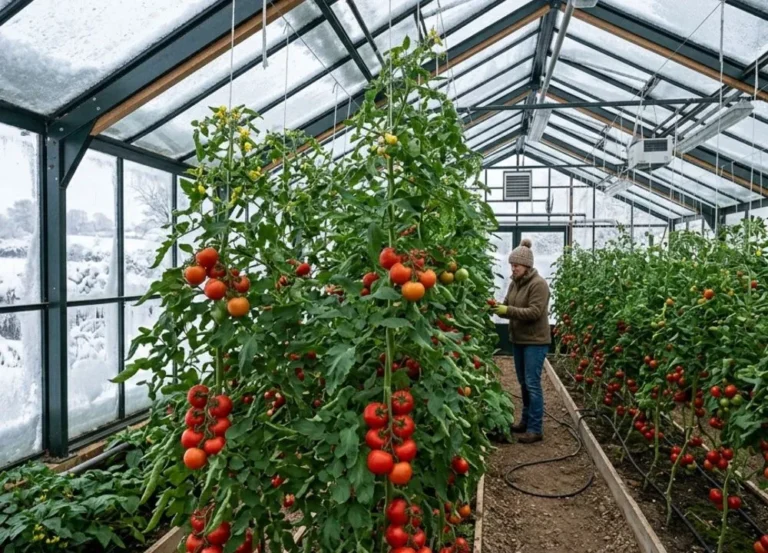
A garden bed frozen solid does not have to mean an empty kitchen table. Once the usual steps to prepare a garden for winter are done outside, stepping into a greenhouse just a few feet away shows how different the equation becomes.
Growing tomatoes indoors on a windowsill or under a grow light works, but it has real ceilings on space and yield. A greenhouse removes many of those ceilings by giving the plant something closer to real outdoor conditions, just shielded from the worst of winter.
That shield is not automatic, though. Glass and plastic alone slow heat loss, but they rarely stop a hard freeze on their own, which is exactly why the details matter here.
What separates a thriving winter greenhouse tomato crop from a dead one usually comes down to one single factor: how much heat the structure actually gets. That factor shapes everything else covered in this guide, so it is worth understanding clearly before anything else.
- Can You Grow Tomatoes in a Greenhouse in the Winter?
- Unheated Greenhouse (Cold Frame Style)
- Minimally Heated Greenhouse
- Fully Heated Greenhouse
- Heated Greenhouse Tomatoes Winter
- Winter Greenhouse Temperature for Tomatoes
- Choosing the Right Tomato Variety for Winter Greenhouse Growing
- Managing Light, Humidity, and Pollination in a Winter Greenhouse
- Common Problems When Growing Greenhouse Tomatoes in Winter
- Why a Winter Greenhouse Harvest Is Worth the Extra Effort
Can You Grow Tomatoes in a Greenhouse in the Winter?
Yes, tomatoes can be grown in a greenhouse through winter, though success depends heavily on how much heat the structure receives.
A greenhouse with no heat source behaves very differently from one running a furnace around the clock, even if both look identical from the outside.
That heating level, more than size, shape, or building material, determines whether plants merely survive or actually produce a real harvest.
The next few sections walk through each heating category, from bare-bones unheated structures up through fully climate-controlled setups, so you can see where your own greenhouse fits.
Unheated Greenhouse (Cold Frame Style)
An unheated greenhouse relies entirely on trapped sunlight and stored heat to keep plants above freezing.
During the day, sunlight warms the air and the soil, and materials like stone, water barrels, or concrete slowly release that stored warmth after dark.
This works reasonably well through mild winter nights, but it offers little protection once outside temperatures drop into the twenties or lower. Checking regional frost dates and typical growing season length beforehand gives a realistic sense of how much protection an unheated structure will actually need to survive.
Growers running unheated structures often lean on a few extra layers of protection:
- Row covers or frost blankets draped directly over plants on cold nights.
- Water-filled containers placed near plants to release stored daytime heat.
- Bubble wrap or extra plastic sheeting lining the interior walls.
Even with these additions, an unheated greenhouse mainly extends the growing season rather than guaranteeing a true midwinter harvest, especially in colder regions where nighttime lows regularly fall below freezing.
Minimally Heated Greenhouse
A minimally heated greenhouse adds just enough supplemental warmth to keep temperatures from crashing on the coldest nights, without running full climate control.
A small space heater, a heat mat under the containers, or a basic thermostat-controlled unit usually does the job.
The goal here is not comfort around the clock. It is simply preventing the plant from dropping into frost-damage territory while the sun is down.
This middle-ground approach suits growers who want more reliability than an unheated structure offers, but who are not ready to commit to a full heating system and its ongoing running costs.
It also works well in regions where winters stay cold but rarely brutal, since a modest heat source can bridge that gap comfortably.
Fully Heated Greenhouse
A fully heated greenhouse keeps temperatures within a consistent, plant-friendly range no matter what the weather outside is doing.
This level of control removes the guesswork entirely. The plant experiences something close to a stable spring or early summer environment, regardless of the calendar.
That consistency is what makes a genuine, reliable winter tomato harvest realistic, rather than a matter of luck or a mild season.
It does come at a real cost, though, both in equipment and ongoing energy use, which the next section breaks down in practical terms.
Heated Greenhouse Tomatoes Winter
Running a fully heated greenhouse through winter means choosing an actual heating system, not just a backup plan for occasional cold snaps.
Three main options dominate this space, and each comes with its own trade-offs in cost, installation, and day-to-day upkeep.
One grower running a modest 300 square foot greenhouse reported using roughly 30 to 40 pounds of propane per week during the coldest stretch of winter just to hold conditions near 55 degrees Fahrenheit, which gives a real sense of the ongoing fuel demand involved.
Propane and Natural Gas Heaters
Propane and natural gas units remain the standard choice for larger greenhouses, since they deliver strong heat output at a lower cost per unit of energy than electric resistance heating.
As a useful side effect, the combustion process also releases carbon dioxide, which plants can use during growth in a sealed or semi-sealed space.
Electric Heaters
Electric heaters suit smaller greenhouses or situations where running a gas line simply is not practical.
They install easily, produce no combustion fumes, and pair well with a basic thermostat, though they typically cost more to run per unit of heat than gas options.
Sizing and Efficiency
A commonly used rule of thumb estimates roughly one BTU of heat per hour for every square foot of floor area, for each degree of difference between the target indoor temperature and the coldest expected outdoor temperature.
Sealing air leaks, adding interior insulation, and using a reliable thermostat all reduce how hard any heating system has to work, which directly lowers the winter fuel bill.
The University of Minnesota’s Deep Winter Greenhouse tomato production trial offers detailed, real-world data on balancing heating input against actual winter tomato output, useful reading for anyone weighing whether the investment pays off.
Winter Greenhouse Temperature for Tomatoes
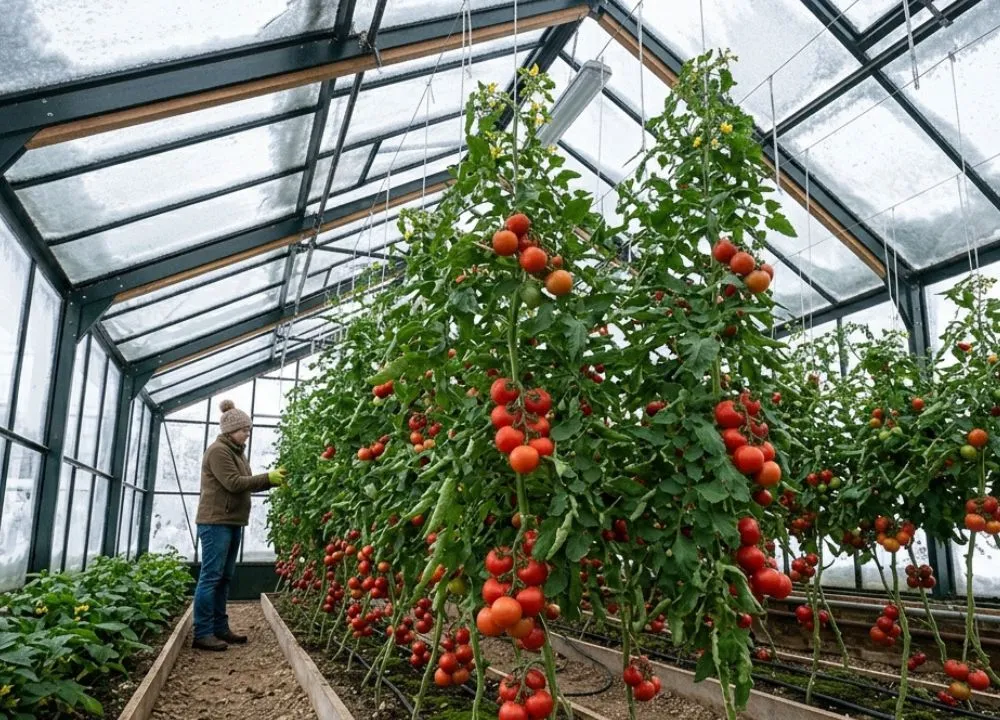
Tomatoes respond to temperature differently depending on their growth stage, and winter greenhouse growers need to track more than one number.
Research from the University of California Agriculture and Natural Resources found that prolonged exposure below 55 degrees Fahrenheit reduces the plant’s ability to photosynthesize and absorb nutrients properly.
The sections below break that threshold down stage by stage.
Germination and Early Seedlings
Seeds germinate best in soil kept between 70 and 80 degrees Fahrenheit, and cooler soil dramatically slows or stalls sprouting.
Young seedlings are especially fragile, since a single cold night can stunt growth that never fully recovers.
Vegetative Growth
Established plants tolerate a slightly wider range, generally staying healthy between 65 and 80 degrees Fahrenheit during the day.
Once temperatures fall into the 50 to 55 degree range for extended stretches, growth slows noticeably and the plant starts diverting energy toward survival rather than new leaves.
Flowering and Fruit Set
Flowering is the most temperature-sensitive stage of all. Nights consistently below 55 degrees Fahrenheit often cause flowers to drop before pollination ever happens.
Daytime highs above 90 degrees Fahrenheit cause similar problems, so fruiting plants actually want a fairly narrow, steady band rather than wide swings in either direction.
The Point of No Return
Frost damage sets in once temperatures reach 32 degrees Fahrenheit, and the damage is immediate and permanent once ice forms inside plant tissue.
Any heating strategy, however modest, needs to keep the greenhouse reliably above this line if the goal is to protect the crop rather than simply extend a season by a few weeks.
Choosing the Right Tomato Variety for Winter Greenhouse Growing
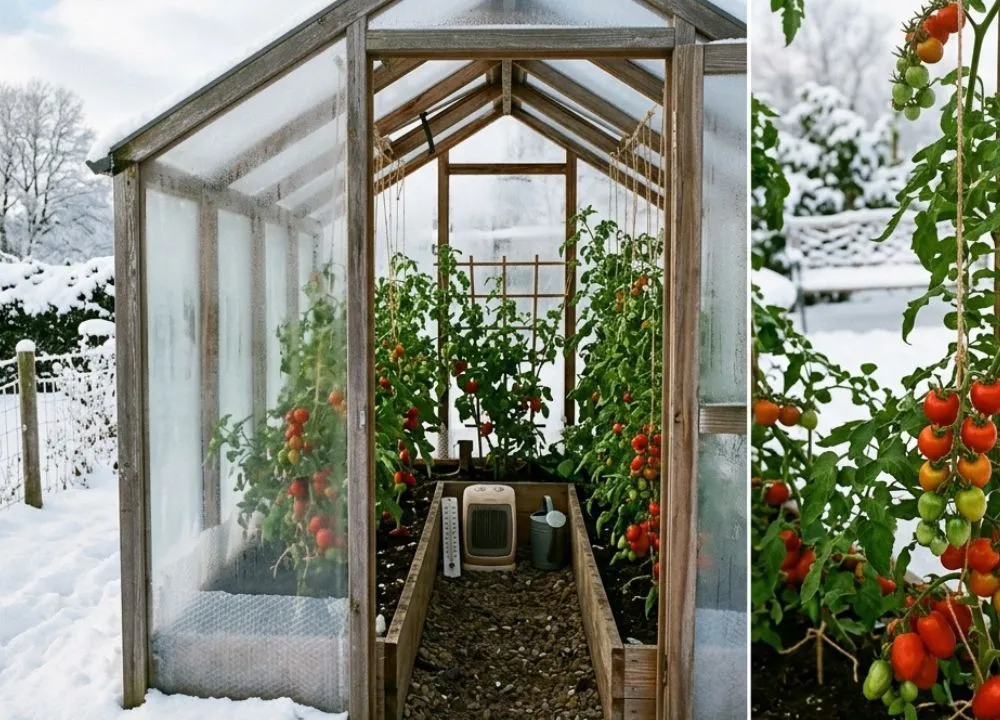
Variety choice should line up with whatever heating level you settled on earlier, since a plant bred for a heated commercial greenhouse behaves very differently in a cold, unheated structure. Knowing what a mature tomato plant typically looks like at each stage also helps you judge whether a struggling plant is simply young or genuinely stressed by the cold.
For unheated or minimally heated setups, look toward cold-tolerant, shorter-season varieties bred to set fruit even when nights run cool.
A few reliable choices for cooler greenhouse conditions include:
- Siberian, a variety bred specifically to set fruit in cold, short-season climates.
- Glacier, an early producer known for tolerating chilly nights better than most.
- Stupice, a compact plant that ripens quickly even under reduced light and warmth.
Fully heated greenhouses have far more flexibility, since steady warmth supports standard greenhouse tomato varieties bred for continuous production, including indeterminate types that keep producing over many months. Getting the sowing date right matters just as much as the variety itself, and the best time to plant tomato seeds shifts earlier or later depending on how much supplemental heat your greenhouse can provide.
Managing Light, Humidity, and Pollination in a Winter Greenhouse
Temperature draws most of the attention, but three other factors decide whether a greenhouse crop actually thrives through winter.
Shorter days, damp indoor air, and the total absence of outdoor pollinators all create separate challenges that heating alone cannot fix.
Supplemental Lighting for Shorter Days
Winter daylight often falls well short of what a fruiting tomato plant wants, even inside a glass structure that lets sunlight through freely.
Full-spectrum LED grow lights, run for an additional four to six hours beyond natural daylight, close that gap effectively.
Humidity and Airflow
Damp, humid air inside a greenhouse creates the exact conditions gray mold needs to spread, and that risk rises sharply once relative humidity climbs past 80 percent.
Running vents for at least part of the night, even in a heated structure, keeps moist air moving out before it condenses on leaves and stems.
Hand-Pollinating Without Bees or Wind
A greenhouse blocks the wind and keeps bees outside, so pollination becomes a manual task exactly the same way it does in a purely indoor setup. A look at the basic parts of a flower and what each part does makes the process easier to visualize.
A gentle shake of the flower cluster, or a light tap with a small brush, moves pollen between the flower’s own male and female parts effectively.
Common Problems When Growing Greenhouse Tomatoes in Winter
Even a well-heated, well-sealed greenhouse runs into a handful of recurring winter issues, most of them tied to moisture and temperature stability rather than the plant itself. Working through the common reasons plants struggle in their environment is a useful first step whenever a greenhouse tomato looks off but the cause is not obvious.
Catching these problems early keeps a small issue from turning into a lost crop.
Condensation and Gray Mold
Warm, moist greenhouse air cools quickly once the sun goes down, and that temperature drop causes water to condense directly on leaves and fruit.
Gray mold spores need only four to eight hours of that surface moisture to germinate, so unchecked condensation can trigger visible infection within a couple of days.
Daily ventilation, even brief nighttime venting, keeps humidity from climbing into the range where the fungus thrives.
Poor Fruit Set Despite Healthy-Looking Plants
A plant can look green and vigorous while still failing to set fruit, and this usually points to missed pollination rather than any nutrient problem.
Increasing how often flowers get shaken or brushed, and checking that night temperatures are not dipping below the 55 degree threshold, usually resolves it.
Sharp Swings Between Day and Night
A greenhouse that heats up fast in weak winter sun and then cools sharply after dark puts real stress on the plant, even if both extremes stay within a survivable range on their own.
Thermal mass, such as water barrels or stone flooring, smooths out that swing by absorbing daytime heat and releasing it slowly overnight. Watering consistency matters here too, and comparing symptoms against an overwatered tomato plant helps rule out a second, unrelated stress hiding behind the temperature swings.
Why a Winter Greenhouse Harvest Is Worth the Extra Effort
Running a greenhouse through winter is not cheap, and it is not hands-off. Heating bills climb, humidity needs daily attention, and every flower needs a human standing in for the bees.
None of that changes what the payoff looks like. Compared with plants that produce fruit steadily all summer long outdoors with no help at all, a winter greenhouse crop demands real work for every single tomato it delivers.
For anyone willing to manage the heat, the moisture, and the pollination by hand, a greenhouse turns winter from a season of waiting into a season of harvesting, one ripe tomato at a time.