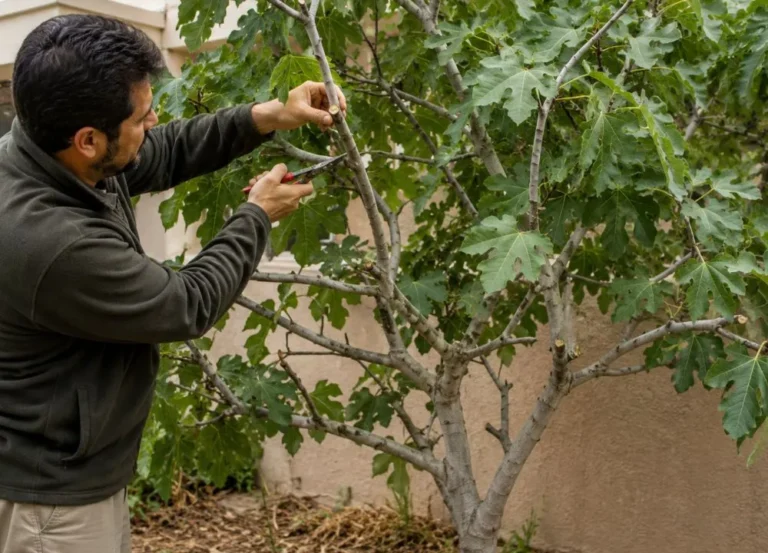
You stand over a bare fig tree, pruners in hand, unsure where the first cut should go. Fig trees drop their leaves and sink into dormancy, and that quiet stretch is your best chance to shape them.
Cut at the wrong moment and the tree bleeds milky sap, sheds fruit, and seals over slowly. Leave it alone too long and next summer’s figs vanish inside a crowded, shaded tangle of stems.
There is also a fruiting trap most beginners fall into, where one heavy winter cut quietly erases an entire early crop. This guide walks every cut in plain steps and pairs them with a fig tree pruning diagram for winter, so you can picture the shape before you commit.
- How to Prune a Fig Tree for Winter?
- How to Prune a Fig Tree Diagram in Winter?
- How to Trim Fig Tree for Winter?
- Setting Your Fig Tree Up for a Heavier Next Harvest
How to Prune a Fig Tree for Winter?
Winter pruning does three jobs at once. It sets the tree’s shape, clears out trouble, and steers energy into next year’s fruit.
Because figs are deciduous, they power down hard once the cold arrives and pull their reserves into the roots.
That deep rest is exactly why bold cuts barely faze a dormant fig, while the same cuts in summer would shock it.
The Right Time to Make Winter Cuts
Aim for the tail end of dormancy, after the leaves have fallen and before the buds start to swell.
Your exact window shifts with your climate, so let the local frost pattern guide you rather than the calendar.
- Warm zones 9 to 11: prune in January, before early bud break
- Zones 6 to 9: prune from mid-February into early March
- Cold zones 4 to 6: wait until the worst freezes pass, then assess
There is a hidden reason to wait for full dormancy, and it is sticky.
The Sticky Reason Timing Really Matters
Slice into a fig during active growth and it weeps a thick, white latex from the wound. That sap draws sap-sucking pests and hands disease an open door straight into fresh cuts. A dormant fig holds most of that latex back, so wounds stay cleaner and knit over far faster.
Tools and Safety for Clean Winter Cuts
Sharp, clean tools decide whether a wound heals smoothly or turns into a ragged rot pocket. Match the tool to the branch, and wipe blades with rubbing alcohol between trees to stop disease spreading.
- Bypass pruners for thin shoots and twiggy tips
- Loppers for branches too thick for hand pruners
- A pruning saw for older, heavier limbs
- Sturdy gloves and long sleeves for sap protection
That last point is not optional. Fig latex on bare skin can react with sunlight and raise a painful, blistering rash, so cover up every time.
How Figs Fruit: Breba and Main Crop
This single fact changes every cut you make, so it deserves a moment before you start. The common fig can carry two crops a year, and each one grows on a different kind of wood.
- The breba crop forms on last year’s wood, ripening in early summer
- The main crop forms on the current season’s new growth, ripening in late summer
Georgia gardening educator Walter Reeves explains that cutting away all the old wood in winter wipes out that early breba crop entirely.
In mild-winter areas, such as figs grown in Georgia, the old wood survives the season and rewards you with those first summer figs.
Not every variety sets a reliable breba, though, so a heavy prune costs you little if yours never produces one.
In cold regions where the tree dies back each winter, the breba is gone regardless, and a harder cut simply fuels a strong main crop.
Pruning a Newly Planted Fig Tree in Its First Winter
A first-winter fig needs shaping, not stripping. You are sketching a skeleton here, not fighting overgrowth.
Aim for a low, open frame so that future figs stay within easy reach rather than climbing out of sight.
Trees planted in the fall and rested through a mild dormancy settle in nicely before this first shaping.
That same sleepy window also suits any relocation, which is why growers transplant figs now instead of in the heat of summer.
Resist the pull to chase a full shape this year. Light, patient cuts now repay you across every winter that follows.
The First Big Cut on a New Whip
If you planted a single unbranched stem, called a whip, cut it back by about half its height.
That one bold snip feels drastic, but it forces the tree to push out low side shoots in spring.
Those new shoots become the low branches you will train into a wide, open frame over the next couple of seasons.
Pruning a Young, Establishing Fig Tree (Years Two to Three)
By the second and third winters, your fig has real options, and now you choose its lasting shape.
Cut the branches you keep back by roughly a third to a half, always to an outward-facing bud.
Snip about a quarter inch above that bud at a slight angle, so water runs off the wound instead of pooling.
Remove anything shooting straight up through the middle, since an open core lets light and air flood the tree.
Steady training across these years keeps the tree healthy and productive far longer than one rushed session ever could.
Picking Scaffolds You Will Keep for Good
Choose three to five strong branches to serve as scaffolds, the permanent limbs that carry every future crop.
Good scaffolds share a few traits worth checking for:
- They fan out evenly around the trunk, not bunched on one side
- They sit at wide angles that resist splitting under fruit
- They stay lower rather than racing skyward
Cut away the rest, then head your keepers back to thicken them and coax branching lower down.
Pruning a Mature, Established Fig Tree
A mature fig asks for a lighter hand than a young one. The frame already stands, so your work turns to upkeep.
Start by clearing the clear problems, then step back and thin whatever still crowds the tree:
- Dead, damaged, or diseased wood, cut back to firm live tissue
- Branches that cross and rub against each other
- Suckers rising from the base and roots
- Watersprouts, the weak vertical shoots crowding the center
Balance is everything with an established tree, so avoid taking more than a fifth to a third of the canopy in one winter.
Figs also need far less cutting than apples or peaches, and a limb comes out best when a younger shoot can take its place.
Make each cut just outside the branch collar, the slightly swollen ring at the base, rather than slicing flush to the trunk.
Reading Winter Damage Before You Cut
In colder regions, a hard freeze often kills the branch tips before you ever pick up your pruners.
Scratch a small patch of bark with your thumbnail, and look for green underneath, which tells you the wood still lives.
Wait until spring when damage shows clearly, then cut each dead section back to that healthy green tissue.
Turning Your Prunings Into New Fig Trees
Do not toss the healthiest trimmings, because strong pieces of that wood can root as cuttings and become whole new trees.
Success leans on picking the right kind of cutting and knowing when to take them from the tree.
You can also pin a low branch down to the soil and let layering raise a fresh plant for you.
Winter Pruning Mistakes That Cost You Figs
A few common slip-ups undo good intentions and cut into next year’s harvest, so watch for these:
- Shearing the tree like a hedge, which triggers a tangled mess of shoots
- Stripping off every scrap of old wood and losing the whole breba crop
- Pruning heavily when the tree only needed a light thinning
- Cutting during a warm spell, which restarts growth right before a frost
- Working bare-armed and paying for it with a sap rash
Get past those, and the cuts themselves become surprisingly simple.
How to Prune a Fig Tree Diagram in Winter?
Words guide your hand, but a picture locks it in. A clear how to prune a fig tree diagram in winter gathers every cut above into one glance.
On the tree, the diagram flags the four things that deserve your attention first:
- Dead wood, marked at the tips and shown cut back to live growth
- Crossing branches, circled where two limbs rub together
- Suckers, arrowed at the base and along the roots
- The open center, drawn as a hollow, cup-like middle
Follow the labels from the outside in. Clear the dead and crossing wood first, then pull the suckers, then judge the shape.
Fruit specialists at Penn State Extension favor this open-center form because it lets sunlight reach right into the heart of the canopy.
Notice how the finished outline sits low and wide, like a shallow bowl, with nothing clogging the middle.
Keep the diagram beside you as a checklist, not a fresh method. Every mark on it traces straight back to the dormant-season cuts you just read.
How to Trim Fig Tree for Winter?
Not every fig needs a full winter overhaul. Sometimes a light trim is all the season calls for.
Trimming means tidying, where you snip wayward tips and stray shoots to keep the tree neat and in bounds.
Structural pruning digs deeper, reshaping the whole frame and deciding which limbs earn a permanent place.
If your fig already holds a good open shape, skip the heavy work and just clear a few crowded twigs.
Container figs and fan-trained trees also lean on trimming, since you mostly shorten leggy growth to hold their tidy form.
In colder spots, such as figs grown in Massachusetts, winter frost often does the cutting for you anyway.
There, the smarter winter move is usually to protect it from a hard freeze rather than prune it hard.
Match the effort to the tree. A tidy fig wants a trim, while a wild or aging one wants real pruning.
Setting Your Fig Tree Up for a Heavier Next Harvest
Every winter cut is really an investment in next year’s figs. You prune now so you can feast later.
According to Michigan State University Extension, dormant-season pruning lifts a tree’s vigor, opens up air flow, and steers energy toward fruit.
A strong, open frame shoulders heavier crops without cracking under the weight of ripe figs.
Better airflow also clears out the damp, disease-friendly pockets that hide deep inside a crowded canopy.
Treat pruning as one piece of a wider routine, right beside the other steps you take to prepare the garden for winter.
Make your cuts while the tree sleeps, then wait. Come summer, a well-shaped fig pays that patience back with a fuller, sweeter harvest.