Tip layering is a propagation method where you bury the growing tip of an arching cane in the soil, so it grows roots and becomes a new plant while still attached to its parent. But there is a deeper truth most guides skip: tip layering is not a trick you apply to any plant. It only works on plants whose biology already spreads this way, and understanding why is the difference between success and a wasted season.
Most people meet tip layering by accident. You are picking blackberries or black raspberries, you notice a cane has arched over, dived into the soil, and quietly grown a whole new plant at its tip, and you think, wait, I could do that on purpose.
You can. And it is arguably the single easiest way to propagate anything in the garden. But the internet is full of “just bury the tip” articles that never tell you the one thing that actually decides whether it works. So let us go deeper than that.
- First, the Plain Definition
- The Part Almost Nobody Explains: Why Only Certain Plants Can Be Tip-Layered
- What Actually Happens Underground
- Tip Layering vs Simple vs Serpentine Layering
- The Real Plant List, Sorted by Whether It Even Works
- A Cultivar Caveat Even Keen Gardeners Miss
- Reading the Cane: Timing Through the Two-Year Cycle
- How to Tip Layer, Step by Step
- The Disease Screen That Most Guides Never Mention
- The Hidden Bonus: Tip-Layering Plants Are Easy to Contain
- Troubleshooting, at a Glance
- Final Thoughts
- FAQs
First, the Plain Definition
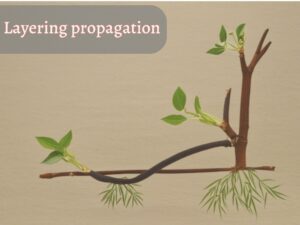
Tip layering means burying only the growing tip of a long, flexible cane, a few inches into the soil, and leaving the rest of the cane attached to the parent plant. Roots form at the buried tip, a new plant develops from it, and the following season you cut it free.
It sits in the wider family of layering propagation methods, but it is the odd one out. Every other layering style buries the middle or the length of a stem. Tip layering buries the one part everyone else leaves exposed: the very tip. If you want the bigger picture, it also helps to understand how layering compares with propagation from cuttings, since the two solve the same problem in very different ways.
The Part Almost Nobody Explains: Why Only Certain Plants Can Be Tip-Layered
Here is the idea that turns tip layering from a random tip into real understanding. A plant can only be tip-layered if that is already how it spreads in nature. You are not forcing a behavior. You are cooperating with one.
Brambles like raspberries and blackberries spread in two completely different ways, and this is the crux of it. According to the University of Maryland Extension, red raspberries and blackberries send up root suckers, new shoots that push up from the roots, sometimes far from the mother plant. Black raspberries do not do this. They produce new growth only from the crown at the base of the plant.
That single biological fact explains everything. Because a black raspberry cannot spread underground through suckers, nature gave it a different escape route: its canes arch over, reach the soil, and root at the tip. So black raspberries are propagated by tip layering precisely because they have no other way to multiply themselves.
New Mexico State University’s horticulture guides make the same point plainly. Because black raspberries do not sucker the way red raspberries do, tip layering is simply their method. Purple raspberries, being a red and black hybrid, mostly grow from the crown too, which is why they tip-layer just like their black parent.
So the rule is not “bury the tip and hope.” The rule is: match the method to how the plant already reproduces. Get that right and success is almost automatic. Get it wrong and no amount of effort helps.
What Actually Happens Underground
Knowing the mechanism makes every step later feel obvious, so it is worth a moment. Roots do not appear randomly along a stem. They appear where the plant’s growth chemistry tells them to.
The growing tip of a cane is the most hormonally active part of the whole plant. It is rich in the natural auxins that trigger new root growth. When you bend the cane sharply and bury that tip in dark, moist soil, you stack three signals on top of each other: the hormone-rich tip, the sharp bend that pools the plant’s energy at that point, and the dark, damp conditions roots love. The plant reads all of that as a clear instruction to root, right there.
Then comes the surprise that unsettles every first-timer. Because the roots grow out of the tip, the new plant effectively starts life upside down. The roots point down, and the new shoot has to reorient and grow back up toward the light. It looks wrong for a week or two, then the plant quietly corrects itself through gravity-sensing growth and straightens out. Nothing has gone wrong. That awkward-looking phase is normal.
Tip Layering vs Simple vs Serpentine Layering
All three bury a stem to grow roots, but they differ in what you bury and how many plants you get. Seeing them together makes the choice clear.
| Method | What You Bury | Plants You Get | Natural Fit |
|---|---|---|---|
| Tip layering | Only the growing tip | One plant per cane | Black raspberries, trailing blackberries |
| Simple layering | The middle of a low stem | One plant | Shrubs with bendy branches |
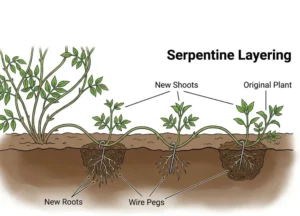
| Serpentine layering | The whole stem, looped in and out | Several plants at once | Long vines like clematis and pothos |
For long, weaving vines, serpentine layering multiplies one stem into many. Another close cousin is trench layering, which lays a whole stem flat in a shallow trench. You can also discover about air layering. For arching berry canes, though, tip layering is the honest match, because those canes are built to root at the tip whether you help them or not.
The Real Plant List, Sorted by Whether It Even Works
This is where most articles fail you with a vague “berries and vines.” Here is the honest breakdown, grouped by how each plant actually spreads.
Tip-layer these, because they root from the crown and tip:
- Black raspberries, the true home of the method
- Purple raspberries, which behave like their black parent
- Trailing and thornless blackberries, whose canes arch to the ground
Do not tip-layer these, divide their suckers instead:
- Red raspberries, which throw suckers from their roots
- Yellow raspberries, which behave like red ones
For red and yellow types, tip layering is the wrong tool entirely. Since they colonize by underground suckers, you simply lift the young suckered plants from the edge of the patch, ideally with a ball of roots attached, and move them. Trying to tip-layer them is effort spent fighting the plant’s nature.
One more distinction worth knowing. Even among the tip-layering brambles, trailing varieties root far more willingly than stiff, upright ones. If a cane bends to the soil without cracking, it will layer. If it stands rigidly upright, it is telling you to try root cuttings instead.
A Cultivar Caveat Even Keen Gardeners Miss
Here is a genuinely obscure one. Not every black raspberry tip-layers equally, and it can even change with the plant’s age.
Some named cultivars are bred to spread less, precisely so growers spend less time pulling up unwanted volunteers. Certain black raspberry selections are documented to seldom tip-root once the plant matures. So if an older, well-behaved cultivar refuses to layer for you, it may not be your technique at all. It may be the variety doing exactly what it was chosen to do.
The practical takeaway: use vigorous, young, first-year canes from a plant that is clearly still in its spreading phase. That is when tip-rooting willingness is at its peak.
Reading the Cane: Timing Through the Two-Year Cycle
Bramble canes live for exactly two years, and tip layering rides that rhythm. In year one, a cane grows tall, then arches over as it lengthens. This first-year cane is called a primocane. In year two, that same cane fruits and then dies.
You always tip-layer a first-year primocane, never a spent fruiting cane. The window opens in late summer, roughly August into September, when the young canes have grown long enough for their tips to reach the ground and are naturally seeking to root. That is the moment to act. This is the same kind of “read the plant, not just the calendar” thinking behind knowing the best time to plant almost anything in your area.
Bury the tips in late summer or early fall, leave them completely alone through the cold months while roots form during dormancy, then separate the new plants in early spring before growth restarts. The plant does the slow work while it sleeps.
How to Tip Layer, Step by Step
The hands-on part takes about ten minutes, spread across two seasons.
Choose a healthy first-year cane. Pick a long, flexible primocane that reaches the ground without snapping, from a vigorous, disease-free plant.
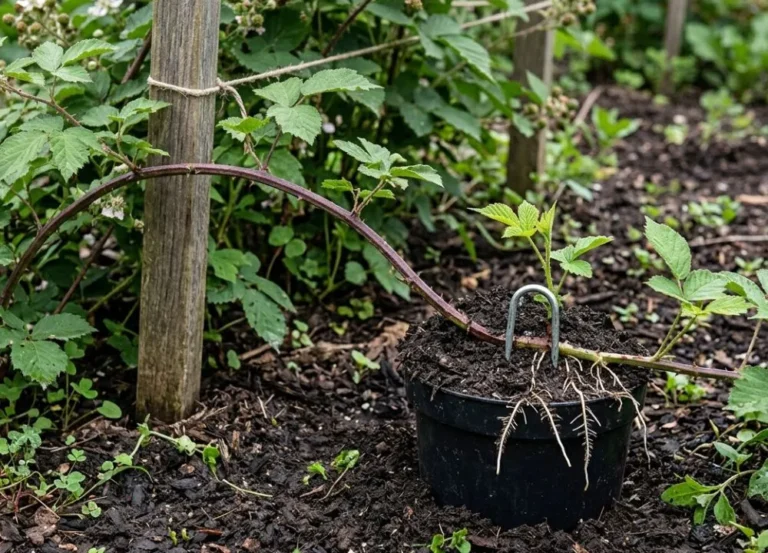
Prepare the landing spot. Loosen the soil where the tip will sit, or sink a pot of moist, well-draining mix into the ground there. A pot makes lifting the rooted plant far cleaner later.
Bury the tip at the right depth. Push the last few inches of the tip into the soil. Two to four inches is standard, and New Mexico State University suggests going a little deeper, around three to five inches, for fall layering. Firm the soil around it.
Pin it down so it stays. A cane springs back if you let it, so hold the buried tip with a landscape staple, bent wire, a brick, or a rock.
Keep it lightly moist, not wet. Water it in and keep the soil damp through the season. A waterlogged tip rots instead of rooting, so it helps to understand the line between moist and wet soil before you overdo it. Watching for the signs a plant needs water keeps the young tip in that safe middle zone.
Wait, then sever correctly. In spring, tug gently to check for firm rooting. When it holds, cut the cane and leave four to six inches of the old cane attached to the new roots, which gives the young plant a handle and a small energy reserve.
The Disease Screen That Most Guides Never Mention
This step separates casual advice from real horticulture, and it matters more than depth or timing. Only ever propagate from a healthy, vigorous, disease-free plant.
Brambles carry a long list of troubles, from viruses like mosaic, which aphids spread plant to plant, to fungal diseases such as cane blight, spur blight, anthracnose, and orange rust. When you tip-layer, you clone the parent exactly, which means you clone its diseases too. This is why extension experts warn against propagating from an unknown patch or a neighbor’s plants, however generous the offer.
If a cane looks weak or its leaves are discolored, pause and find out why the plant might be yellowing before you clone it. A tip-layered plant is only ever as healthy as the cane it came from. Start clean, and you stay clean.
The Hidden Bonus: Tip-Layering Plants Are Easy to Contain
Here is a payoff almost no article connects, and it flows straight from the biology above. Because black and purple raspberries spread only by tip rooting, and because a tip has to physically reach the ground to root, they are remarkably easy to keep in bounds.
You can literally see every attempt at expansion, and you stop it by keeping canes off the soil. Tie them to a fence, a trellis, or a wire, and a tip that never touches earth never becomes a new plant.
Contrast that with red raspberries, which travel underground through rhizomes and can surface several feet away, unseen, until a whole new thicket appears. The very trait that makes black raspberries need tip layering is the same trait that makes them polite garden citizens. Propagation method and containment are two sides of one coin.
Troubleshooting, at a Glance
When tip layering fails, the cause is almost always one of a few things.
- The tip sprang back out. It was not pinned. Re-bury and weigh it down.
- No roots after winter. The soil dried out. Keep it consistently moist next time.
- The buried tip rotted black. The soil stayed too wet. Improve drainage.
- The new plant wilted after cutting. You separated too early. Wait for firm resistance.
- A mature plant simply will not layer. It may be a low-spreading cultivar. Use a younger, more vigorous cane.
Read the pattern and the fix is usually right there: pinning, moisture, patience, or plant choice.
Final Thoughts
Tip layering rewards you twice over. Once with free plants that are exact copies of a berry you already love, and again with a real understanding of how these plants think.
Bury a few first-year tips this coming late summer, from a healthy plant, and leave them to overwinter. By spring you will have new berry bushes that cost nothing, and a genuine feel for why the method works only where nature already paved the way.
FAQs
What is tip layering in simple terms?
It is burying the tip of an arching cane so it roots into a new plant, while still attached to the parent. You cut it free once it has its own roots.
Why can’t red raspberries be tip-layered?
Because red raspberries spread by root suckers instead of tip rooting. To multiply them, you dig up the young suckered plants from the edge of the patch.
Which berries are best for tip layering?
Black raspberries, purple raspberries, and trailing blackberries, all of which naturally root from the crown and tip.
When is the best time to tip-layer?
Late summer to early fall, using first-year canes. The rooted tips are separated the following spring.
How deep should I bury the tip?
About two to four inches, and a little deeper, three to five inches, for fall layering. Firm the soil and pin the tip in place.
Why does my new plant grow sideways at first?
Because roots form at the buried tip, the shoot starts out disoriented. It reorients toward the light and straightens up within a week or two.