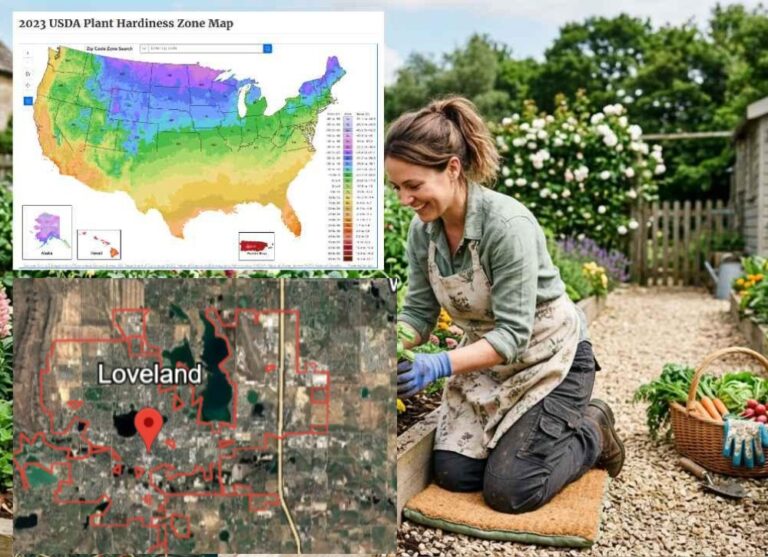
Loveland draws gardeners with its scenic views and fertile land near the Big Thompson River, but the city’s northern Front Range position adds a layer of difficulty that newcomers rarely expect. Late frosts in May, sudden hailstorms in June, and dry summer winds create a combination that punishes poorly timed planting.
Before you buy a single seedling or fruit tree, you need to know your USDA planting zone. It determines which perennials, trees, and shrubs can survive Loveland’s winters, and it shapes the timing for everything else you plant.
This guide covers Loveland’s zone classification, what it means for your yard, and how to use that number to make smarter choices all season long.
Loveland Is Classified as USDA Zone 5b
The 2023 USDA Plant Hardiness Zone Map places Loveland, Colorado in Zone 5b. That translates to average annual extreme minimum winter temperatures of -15°F to -10°F.
This classification comes from 30 years of climate data (1991 to 2020), processed by the PRISM Climate Group at Oregon State University. The map was updated in 2023 and confirmed Loveland’s position in Zone 5b without any change from the previous 2012 version.
Loveland shares this zone with neighboring Fort Collins and Greeley, which all sit along the northern Front Range corridor.
What Zone 5b Tells You About Loveland
Zone 5b is a cold-hardiness rating. It tells you that any perennial plant, tree, or shrub needs to tolerate lows of at least -15°F to reliably survive winter in Loveland without protection.
A plant tagged “Zone 5” on the nursery label should handle Loveland’s winters. A plant labeled “Zone 6 and above” carries real risk of dying back or not recovering after a hard freeze.
What the Zone Number Leaves Out
The zone system focuses only on winter cold. It skips summer heat, wind, soil type, precipitation, and elevation effects entirely.
Loveland sits at roughly 5,000 feet. At that altitude, UV radiation hits plants harder than it does in a lowland Zone 5b city like Des Moines or Indianapolis. Rainfall averages around 15 inches per year, which is well below the national average. These factors create growing conditions that feel harsher than the zone number suggests.
If you have read about the zone 5 frost dates and growing season, you already know that this zone demands careful scheduling around both spring and fall frosts.
Frost Dates and Growing Season Length
For vegetable gardeners, frost dates carry more weight than the zone designation. According to data from Garden.org, Loveland averages about 129 frost-free growing days.
The last spring frost usually falls around May 14. The first fall frost typically arrives near September 20. That gives you a growing window that works for most standard garden vegetables, though barely.
Crops that need 90 or more days to reach harvest, like most tomato varieties, need an indoor head start. Starting seeds in early March gives transplants enough time to produce before fall frost ends the season. You can check specifics on when to plant tomatoes in Colorado for tailored timing.
What Grows Well in Loveland’s Zone 5b
Loveland’s zone supports a broad mix of edibles and ornamentals, as long as you respect the frost calendar and plan for dry conditions.
Vegetables for Loveland Gardens
Cool-season crops thrive in early spring here. Lettuce, spinach, radishes, kale, and peas can go into the ground as early as late March or early April, since they tolerate light frost without damage. More specifics on when to plant lettuce in Colorado can help you dial in exact dates.
Warm-season crops like tomatoes, peppers, squash, cucumbers, and beans should wait until after mid-May. Soil temperature matters as much as air temperature for these, and Loveland’s ground stays cold well into May at this elevation.
Garlic is a strong performer in Zone 5b. The best planting window for garlic in Zone 5 runs from mid-September through October. Cloves overwinter in the soil and are ready to harvest the following July.
Trees and Perennials That Handle -15°F
Apple trees, tart cherry trees, and cold-hardy peach varieties do well in Loveland if planted in a sheltered spot with good drainage. The city’s proximity to the foothills gives it occasional chinook winds that provide brief winter warming, but also cause rapid temperature swings that stress bark on young trees.
Reliable perennials for Zone 5b include coneflower, yarrow, catmint, sedum, and ornamental grasses like blue fescue. These all handle Loveland’s cold winters and tolerate dry summers without constant irrigation.
How Loveland Compares to Other Colorado Cities
Loveland’s 5b designation places it in a cooler band than much of the Denver metro area. Cities like Denver, Aurora, and Lakewood sit in Zone 6a, where winter lows only reach -10°F to -5°F.
That difference of one half-zone means Denver-area gardeners can grow certain marginally hardy plants that Loveland gardeners cannot. Conversely, heading west into the mountains pushes zones down quickly. Boulder straddles the 5b line as well, and mountain towns like Vail drop into Zone 5a or lower.
South along I-25, Colorado Springs holds a mix of 5b and 6a depending on neighborhood elevation.
Practical Tips for Zone 5b Gardening in Loveland
Loveland’s climate rewards preparation more than improvisation. A few targeted strategies make a real difference in how your garden performs.
Mulch perennial beds heavily in late October or early November. A 3-to-4-inch layer of wood chips or straw insulates roots through the deepest cold spells. For a full seasonal walkthrough, read about how to prepare your garden for winter.
Water deeply and less frequently. Loveland’s clay-loam soil holds moisture longer than sandy soil, but the dry air and low rainfall mean you still need to irrigate consistently during summer. Knowing how often to water your plants prevents both wilting and root problems.
Use row covers or cold frames to extend the season on both ends. In a Zone 5b city with only 129 frost-free days, even two extra weeks of protection in spring and fall can make the difference between a tomato harvest and a failed crop.
Final Thoughts
Loveland, Colorado falls in USDA Hardiness Zone 5b, with average winter lows between -15°F and -10°F. The city averages around 129 frost-free days, running roughly from mid-May to mid-September.
That zone number is your foundation for selecting plants that will survive here long-term. Pair it with Loveland’s frost dates, altitude, and low rainfall, and you have a clear picture of what your garden needs to succeed in this part of northern Colorado.