Every gardener in Andover eventually runs into the same wall. You buy a shrub or a packet of seeds, and the tag mentions a zone number you have never checked for your own yard.
That gap matters more than it seems. Plant a tree rated for a warmer climate, and it may struggle through winter or die outright once the cold settles in.
The tricky part is that Andover is not one flat, uniform climate. Small pockets of the town run colder or warmer than what a general map might suggest, and that nuance trips up even experienced growers.
This piece walks through the town’s official zone, the local quirks that shift it street by street, and the plants that actually hold up once winter arrives. For a wider look at how zones work across the state, see our guide on what planting zone Massachusetts falls under.
What Planting Zone Is Andover, MA?
Andover sits within USDA Hardiness Zone 6b, with parts of the town falling into 6a.
That means winter lows typically bottom out somewhere between negative 10 and 0 degrees Fahrenheit, depending on which section of town you’re standing in.
This number comes from the federal government’s own climate tracking system, not a private estimate or a rough guess.
Knowing this zone number is the first real step toward picking plants that survive Andover’s winters instead of fighting a losing battle against the cold.
- What Planting Zone Is Andover, MA?
- Andover’s Official USDA Hardiness Zone Classification
- How Elevation Changes the Zone Within Andover
- Low-Lying, Riverside, and Wetland Areas
- Downtown and Densely Developed Areas
- How to Find Your Exact Planting Zone by Zip Code
- Understanding the USDA Hardiness Zone Map
- Andover, MA First and Last Frost Dates
- Best Plants for Zone 6b in Massachusetts
- Massachusetts Planting Zones by City
- Turning Andover’s Zone Knowledge Into a Successful Garden
Andover’s Official USDA Hardiness Zone Classification
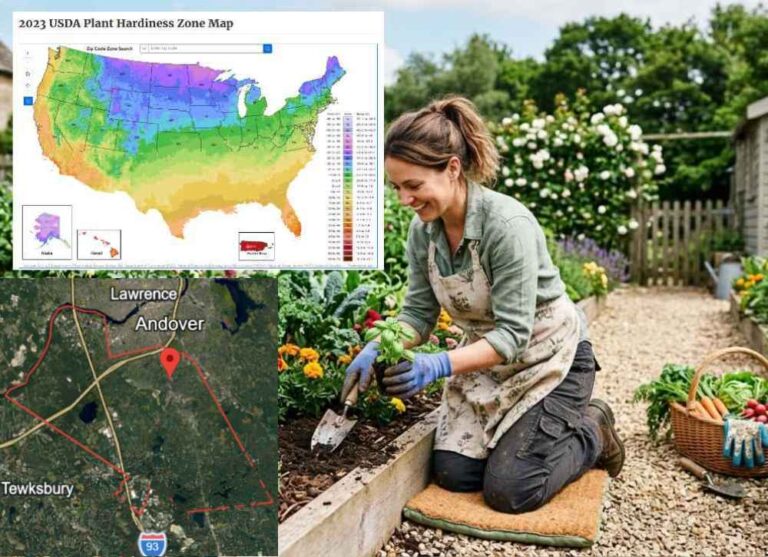
According to Plantmaps’ breakdown of the 2023 USDA Hardiness Zone Map, Andover’s zip code of 01810 spans both Zone 6a and Zone 6b.
Zone 6a covers winter lows from negative 10 to negative 5 degrees, while Zone 6b runs from negative 5 up to 0 degrees.
This marks a shift from the 2012 map, when the entire town sat firmly in the colder Zone 6a.
The change reflects updated climate data gathered between 1991 and 2020, replacing the older data set that ran through 2005.
So while older plant tags or gardening books might still reference 6a, the newer, more accurate reading places much of Andover half a zone warmer. Our broader regional gardening guide covers how these shifts have played out across other New England towns too.
How Elevation Changes the Zone Within Andover
Andover’s terrain rolls rather than sits flat, and that rolling landscape creates real temperature swings from one neighborhood to the next.
Cold air is heavier than warm air, so it naturally sinks and pools at the bottom of hills and valleys.
Homes sitting on higher ground, especially toward the town’s northern and western sections, often see winter lows that land closer to Zone 6a.
Gardeners on these elevated lots should treat borderline perennials with extra caution, since a few degrees can decide whether a plant survives February.
Low-Lying, Riverside, and Wetland Areas
Land near the Shawsheen River and other low, damp sections of Andover behaves differently than the drier, higher parts of town.
Cold air drains downhill and settles into these low spots overnight, creating what growers call a frost pocket.
Even on nights when most of Andover stays just above freezing, these riverside and wetland areas can dip a few extra degrees colder.
Gardeners near the Shawsheen or in low-lying yards should plan for frost to arrive earlier in fall and linger later into spring than the town average suggests.
This local effect can quietly push these specific pockets toward the colder edge of Zone 6a, even if the surrounding blocks read as 6b.
Downtown and Densely Developed Areas
Paved streets, brick buildings, and packed parking lots hold onto daytime heat and release it slowly after dark.
This effect, often called urban heat retention, keeps Andover’s downtown core and other heavily built sections a touch warmer overnight than open, grassy land nearby.
That small temperature bump can nudge a densely developed block toward the milder end of Zone 6b, even while nearby open fields read colder.
Gardeners with small downtown lots sometimes find that borderline plants, ones that might struggle in the open countryside, hold on a little better surrounded by pavement and brick.
How to Find Your Exact Planting Zone by Zip Code
The most reliable way to confirm your specific zone is to check your address directly, since Andover spans more than one classification.
Visit the official USDA Plant Hardiness Zone Map and enter your Andover zip code into the search box on the interactive map.
The tool will return your exact zone along with the average winter low temperature range tied to that specific location.
For homes near a known cold spot, like a riverside lot or a hilltop, treat the tool’s answer as a helpful baseline rather than a strict guarantee.
Cross-checking with a neighbor’s experience or a local nursery can round out what the zip code lookup tells you.
Understanding the USDA Hardiness Zone Map
The USDA Hardiness Zone Map measures one specific thing: the average coldest temperature a location experiences each winter.
That single number then gets sorted into a system of zones, each covering a 10-degree range, and split further into “a” and “b” half zones covering 5 degrees each.
The first version of this map dates back to 1927, created by a researcher named Alfred Rehder, and the USDA has only revised it a handful of times since.
Nurseries, seed companies, and plant tags all lean on this same zone system, which is why matching your zone to a plant’s rating matters before you buy anything.
Andover, MA First and Last Frost Dates
Andover’s average last spring frost typically falls between May 1 and May 10, based on regional frost date tracking for the area.
The average first fall frost tends to arrive between October 11 and October 20, marking the practical end of the growing season.
Between those two dates sits Andover’s real growing window, roughly five months where most tender plants can grow without freezing damage.
Planting warm-season crops too early, before that spring frost window closes, risks losing seedlings to a late cold snap. Our spring planting guide walks through how to time that window safely.
Waiting too long into fall carries the opposite risk, where an early frost cuts a harvest short before it finishes, something our fall planting guide covers in more depth.
Best Plants for Zone 6b in Massachusetts
Zone 6b in Massachusetts supports a wide range of vegetables, flowers, shrubs, and trees, provided they go in the ground at the right time.
Vegetables that reliably handle this zone include:
- Tomatoes, peppers, and cucumbers are planted after the last spring frost passes
- Leafy greens like lettuce and spinach, which tolerate cooler spring and fall temperatures
- Garlic, planted in fall for a summer harvest the following year
- Winter squash and pumpkins, which need the zone’s full frost-free stretch to mature
Flowers and shrubs suited to this zone include:
- Hydrangeas, which handle Zone 6b winters without special protection
- Peonies, a hardy perennial that returns reliably year after year
- Daylilies, tolerant of both cold winters and Andover’s summer heat
- Rhododendrons, provided they’re planted in a spot shielded from harsh winter wind.
Trees that hold up well in this zone include red maple, white oak, and flowering dogwood, all of which handle the region’s winter lows without extra winter protection. Whatever you choose, keeping a consistent watering routine matters just as much as the zone rating; our plant watering guide breaks down how often each type needs it.
Massachusetts Planting Zones by City
Comparing Andover to nearby cities helps put its zone into context.
Boston, closer to the coast and warmed slightly by the ocean, sits in Zone 7a, a half zone milder than most of Andover.
Worcester, further inland and at a higher elevation, falls into the cooler Zone 6a range, similar to Andover’s colder pockets.
Lowell, sitting close to Andover geographically, largely shares its Zone 6a and 6b split.
Western Massachusetts towns near the Berkshires drop as cold as Zone 5b, a full zone or more colder than anything found in Andover, while coastal spots like Cape Cod run milder than the inland average.
Turning Andover’s Zone Knowledge Into a Successful Garden
Andover sits mainly in Zone 6b, with cooler pockets of 6a on higher ground and near the Shawsheen River.
Use the official zip code lookup tool to confirm your exact reading, then factor in whether your yard sits on a hill, near water, or close to downtown pavement.
Time your planting around the town’s typical frost window, roughly May 1 through October 20, and lean toward vegetables, shrubs, and trees proven to handle Zone 6b winters.
Treat the zone number as a starting point, then adjust based on what you actually observe in your own soil and yard each season. Once the growing season winds down, our winter garden prep guide covers how to protect what you’ve planted through Andover’s coldest months.