Colorado is one of the most rewarding and most unforgiving states for growing tomatoes. The sunshine is abundant, the soil in many areas is fertile, and a perfectly ripe tomato at altitude somehow tastes sharper and sweeter than it has any right to.
But getting to that harvest requires navigating a set of watering challenges that most gardening guides barely acknowledge. The air is dry. The elevation speeds up evaporation. The UV intensity pushes plants to transpire moisture faster than they would at sea level. And just when you think you have a rhythm going, a May snowstorm or a July hailstorm throws everything sideways.
Generic watering advice, the kind that says give tomato plants one inch per week, was written for places with moderate humidity, stable temperatures, and predictable rain. Colorado checks none of those boxes. If you have been following that standard rule and watching your plants struggle, the altitude is working against you in ways that basic guides do not account for.
This guide covers how often to water tomatoes in Colorado based on your elevation zone, soil conditions, and the unpredictable weather that defines this state.
- How Often to Water Tomatoes in Colorado
- How Much Water Does a Tomato Plant Take in Colorado
- How Often to Water Tomato Plants in Colorado
- Why Colorado's Dry Air and Altitude Change Everything About Watering
- Managing Tomato Watering Through Colorado's Unpredictable Weather
- Best Watering Methods for Colorado's Arid Growing Conditions
- Why Generic Watering Advice Fails in Colorado's High-Altitude Gardens
How Often to Water Tomatoes in Colorado
Colorado tomato plants generally need more frequent watering than national guidelines suggest. The combination of low humidity, intense sun, and thin air at altitude pulls moisture from both soil and leaves faster than most gardeners expect.
As a baseline, plan to water your tomato plants every two to three days during the active growing season. According to Colorado State University Extension, tomatoes need warm, consistent conditions to produce well, and the state’s wide daily temperature swings make maintaining steady soil moisture especially important.
That two-to-three-day starting point will shift depending on your specific elevation, soil type, and whether the week brings ninety-degree heat or an unexpected cold snap. Understanding how often you should water plants as a general principle is helpful, but Colorado demands altitude-specific adjustments that the sections below provide.
Watering at Front Range Elevations (5,000 to 6,500 ft)
The Front Range, including Denver, Boulder, Fort Collins, and Colorado Springs, is where most Colorado gardeners grow their tomatoes. Elevation here ranges from roughly 5,000 to 6,500 feet, which is high enough to noticeably affect evaporation and plant behavior.
Denver receives only about fifteen inches of annual precipitation, according to the Colorado Climate Center at Colorado State University. For comparison, that is less than one-third of what most eastern U.S. cities receive. Denver’s afternoon relative humidity in summer can drop to thirty-four percent, which means the air actively pulls moisture from soil and foliage throughout the day.
The Front Range also gets more than 300 days of sunshine per year. That intense, direct sunlight at a mile above sea level hits harder than the same sunlight at lower elevations because the thinner atmosphere filters less UV radiation. Plants respond by transpiring faster, which increases their water demand beyond what you might expect based on temperature alone.
Water Front Range tomatoes every two to three days during the growing season. On weeks with temperatures above ninety degrees and no rain, you may need to water every other day. The soil in many Front Range communities, including Aurora and Broomfield, is alkaline clay, which dries and cracks at the surface but can hold moisture deeper down. Check at the two-to-three-inch depth before adding water.
Watering at Higher Mountain Elevations (7,000 to 9,000+ ft)
Growing tomatoes at mountain elevations is possible, but the watering dynamics get trickier. The air is even drier, the UV intensity increases further, and the growing season shrinks considerably. Areas like Durango and Castle Rock fall into transitional elevation zones where these factors begin to intensify. Colorado State University Extension notes that the last frost in many mountain areas occurs in mid-May, with the first frost returning by early October, giving growers a narrow window.
The paradox at higher elevations is that temperatures are cooler, so you might expect plants to need less water. But the drier air and stronger sun actually accelerate soil surface drying. The Colorado Climate Center confirms that the state’s high elevation and low humidity favor rapid evaporation, even when temperatures stay moderate.
Water mountain-elevation tomatoes every two to three days. At elevations above 8,000 feet, cool nighttime temperatures slow overnight evaporation, but daytime drying can be aggressive. Morning watering is critical here because evening moisture on foliage combined with cool mountain nights creates ideal conditions for fungal diseases.
Container-grown tomatoes at altitude need special attention. The dry air and wind can pull moisture from small pots within hours. Expect to water containers daily during the warmest months, and check the signs that your plant needs water more frequently than you would at lower elevations.
Watering on Colorado’s Eastern Plains (3,500 to 5,000 ft)
The eastern plains sit at lower elevations than the Front Range, with hotter summer temperatures, stronger wind exposure, and even less natural shelter. Regions near Grand Junction and Greeley face some of the most intense watering demands in the state. This area grows tomatoes successfully thanks to fertile loamy soils, but water demand is among the highest in Colorado.
Wind is the defining factor on the plains. Even moderate breezes strip moisture from plant leaves and speed up soil surface drying. According to the Colorado Climate Center, seventy to eighty percent of annual precipitation on the plains falls during the growing season from April through September, but much of it arrives as localized, heavy thunderstorms that may miss your garden entirely.
Plan to water every two days during summer, and monitor soil closely during windy stretches. Mulching with three to four inches of straw or wood chips is essential here for holding moisture in the root zone against constant wind exposure. Understanding wet versus moist soil helps you gauge whether your watering is actually reaching the roots or just dampening the surface.
How Much Water Does a Tomato Plant Take in Colorado
In most of the country, the rule of thumb is that tomatoes need about one inch of water per week. In Colorado, that usually falls short.
The arid climate and high evaporation rates mean most Colorado tomato plants need closer to one and a half to two inches of water per week during the peak growing months of July and August. If your garden sits above 6,000 feet, you may need even more during heat spells.
Measuring actual water delivery matters more here than in humid climates. A rain gauge placed in your garden bed tells you exactly how much rainfall you received, so you know how much to supplement with irrigation. When watering, go slowly enough for the soil to absorb moisture at depth rather than allowing it to run off the surface.
For a single mature tomato plant in the ground, a rough target is one to two gallons per watering session, applied two to three times per week. That volume should wet the soil six to eight inches deep, where the main root mass lives. In containers, a large fruiting tomato may take a full gallon per day during a ninety-degree week, especially once heavy fruit production is underway.
How Often to Water Tomato Plants in Colorado
A quick-reference summary for Colorado growers:
- Front Range (5,000 to 6,500 ft): every two to three days
- Mountain elevations (7,000 to 9,000+ ft): every two to three days, morning only
- Eastern Plains (3,500 to 5,000 ft): every two days, more often in wind
- Containers at any elevation: daily, sometimes twice in peak summer
- New transplants: daily for the first ten to fourteen days
Always check soil moisture at two to three inches deep before watering. The surface can look parched in Colorado while the subsurface still holds moisture, which is why the finger test matters more here than in almost any other state.
Why Colorado’s Dry Air and Altitude Change Everything About Watering
The science behind Colorado’s watering challenge comes down to three connected factors that all trace back to elevation.
First, evaporation speeds up at altitude. Thinner air holds less moisture and creates less atmospheric pressure on the soil surface. Water molecules escape into the air more readily than they would at sea level, which means any water you apply, from rain or irrigation, disappears faster from the top layer of soil.
Second, UV intensity increases with elevation. For every 1,000 feet of altitude gained, UV radiation increases by roughly six to eight percent. That stronger light drives tomato plants to transpire more water through their leaves as they photosynthesize. A tomato plant growing at 5,280 feet in Denver loses more water through its foliage per hour than the same plant would in a coastal city at sea level.
Third, there is a gap between surface appearance and root-zone reality. The combination of dry air and intense sun bakes the soil surface quickly, but moisture can persist a few inches down, especially in clay-heavy Front Range soils. This disconnect makes the finger test at depth more important in Colorado than in almost any other state. Learning to read what your plants look like when they need water versus when they are simply reacting to midday heat is a skill that comes with practice.
These three factors work together. They do not simply add a little extra watering need. They multiply each other’s effects, which is why the standard one-inch-per-week advice consistently underperforms in Colorado gardens.
Managing Tomato Watering Through Colorado’s Unpredictable Weather
Colorado’s weather changes faster than almost anywhere in the lower forty-eight states. The old joke about waiting five minutes for different weather is grounded in reality, and it directly affects how you manage water for your tomato plants.
Late spring freezes are common. A warm April week can give way to a May snowstorm, sometimes after tomatoes have already been transplanted. Cold snaps slow plant growth and reduce water uptake, which means the soil stays wet longer. If you maintain your normal watering schedule during a cold snap, you risk waterlogging the roots and triggering rot. Pull back on watering during cool stretches and resume your regular frequency once temperatures stabilize.
Summer hailstorms can damage foliage severely, reducing the plant’s leaf surface area and temporarily lowering its water needs. A heavily defoliated plant uses less water than a fully leafed-out one. After a hail event, reduce watering for several days and let the plant recover before returning to your usual routine. If the damage is severe, understanding whether tomato plants can recover from stress helps you decide whether to nurse the plant back or start fresh.
Temperature swings of thirty to forty degrees within a single day are normal along the Front Range. A morning low of fifty-five degrees and an afternoon high of ninety-five in the same day creates confusing signals. The key is to water in the morning when conditions are cool, so the root zone is fully loaded before the afternoon heat arrives.
Best Watering Methods for Colorado’s Arid Growing Conditions
Not all watering methods work equally well in Colorado. The low humidity and frequent wind mean that any water exposed to the air loses a significant portion to evaporation before it reaches the roots.
Drip irrigation is the single most effective method for Colorado tomato gardens. It delivers water slowly and directly to the root zone, bypassing the leaves and the open air. In a state where every drop counts, this efficiency matters enormously. Colorado State University Extension recommends soaker hoses and drip systems specifically because they minimize evaporative loss.
Overhead sprinklers are the least efficient option here. Wind blows the spray off target, dry air evaporates the droplets in flight, and wet foliage in the afternoon sun can cause leaf scorch. If sprinklers are your only option, run them between four and seven in the morning when wind is calm and evaporation is lowest. If you notice yellowing leaves after overhead watering, switching to a ground-level method often solves the problem.
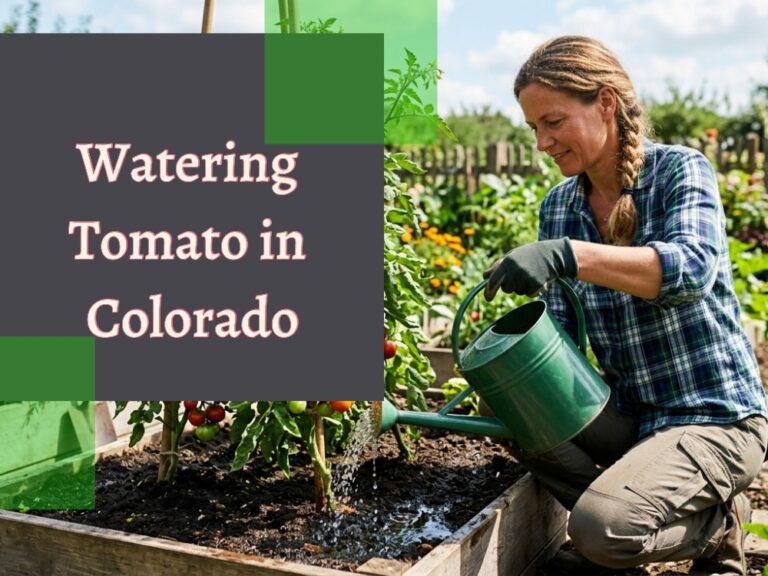
Deep soaking with a slow-running hose at the base of each plant is a simple alternative to drip. Let the water trickle for ten to fifteen minutes per plant so it penetrates deeply rather than spreading across the surface. This method works well for small gardens with just a handful of plants.
Mulching is not a watering method, but it is inseparable from any effective watering strategy in Colorado. Without mulch, the soil surface in a Colorado garden can dry out within hours of a watering session. A two-to-three-inch layer of organic mulch around each plant slows that loss and helps keep plants alive through hot, dry stretches. Keeping a supply of quality potting soil and mulch on hand means you can top up your beds whenever the layer thins out.
Why Generic Watering Advice Fails in Colorado’s High-Altitude Gardens
Colorado occupies a unique space on the American gardening map. No other major population center sits at this elevation, with this level of aridity, under this intensity of sunlight, while also contending with this degree of temperature volatility.
The standard rules were built for sea-level or near-sea-level climates where humidity buffers evaporation, rainfall arrives predictably, and temperature swings stay within a moderate range. Colorado violates every one of those assumptions. That is why following generic guides here leads to stressed plants, cracked fruit, and disappointing harvests.
The gardeners who succeed with tomatoes in Colorado are the ones who stop looking for a fixed schedule and start responding to what their soil, their elevation, and their weather are actually doing. Check the soil. Watch the forecast. Learn to tell the difference between overwatered and underwatered tomato plants so you can correct quickly. If you catch overwatering early, knowing how to save the plant can rescue a season’s worth of effort.
If you are growing above 5,000 feet, plan for more water than you think, protect your plants from wind, mulch heavily, and water early in the day. Those four habits will carry you further than any one-size-fits-all rule ever could. And if you are expanding your Colorado garden beyond tomatoes, guides on when to plant lettuce in Colorado, when to plant garlic in Colorado, and even whether figs can grow in Colorado can help you plan watering across your entire plot.